The men's palette for fall winter 2026 turns on five families that slot together neatly: burgundy as the lead, warm neutrals (chocolate, caramel, cognac), forest and olive green, warm greys and cream. Deep red and a cool blue stay in the mix, but in small doses, as accents.
We won't stop at telling you what's in. We'll tell you where those colors actually go, the office, dinner, a formal event, and how to tie them through the whole outfit, from the coat down to the sock.
A concrete example, to show the method. A camel coat, a taupe-grey suit, a muted burgundy tie and a sock in that same burgundy: the thread of color runs from the knot to the ankle, and the look resolves cleanly, with no jarring break, even when you cross your legs at the table.
Everything starts here. In the sections ahead we take one color at a time and follow it all the way through, from the line of the coat to the detail under the trouser, because that's where most men lose the thread.
Fabric matters as much as shade. A burgundy in certified Filoscozia®, a noble cotton yarn, stays full and deep where a shiny synthetic fades, and a fine yarn holds its color wash after wash: the tonal match you set today still works a year from now.
If you want the full picture of key pieces and silhouettes before getting into color, start with the fall winter 2026 menswear trends.
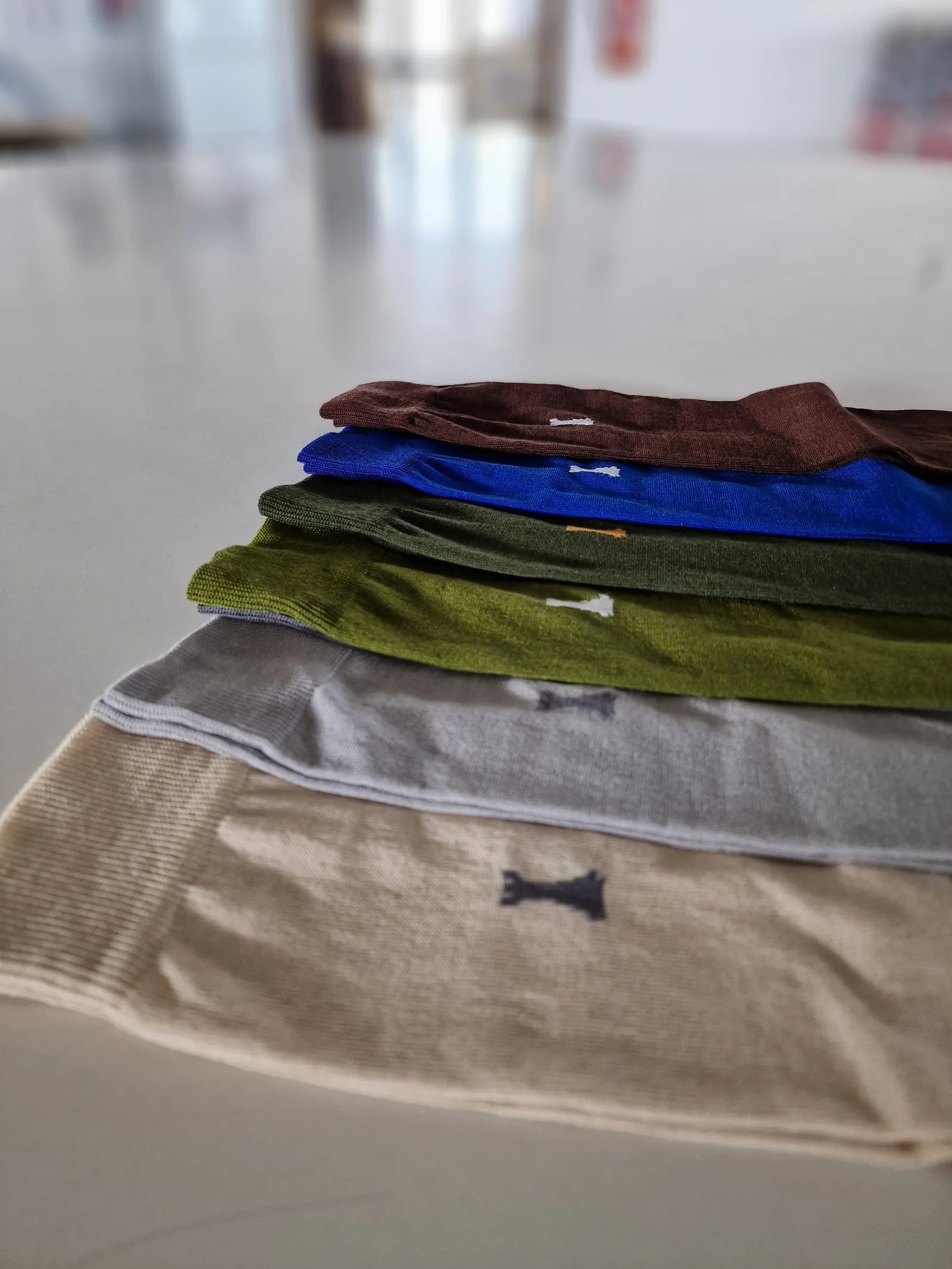

Burgundy, the Lead: It's Not a Red
People who avoid it are thinking of red, but burgundy is something else. It's a deep colour that leans toward purple and brown, with none of the brightness of a true red. That's why it sits easily even on men who usually keep nothing but navy, grey and brown in the wardrobe.
It helps to tell it apart from its close relatives, because they aren't interchangeable:
- Wine: darker, pulling toward black, almost a nocturnal neutral.
- Plum: clearly purple, cooler and less earthy.
- Marsala: warmer and brick-toned, with a hint of burnt orange.
True burgundy sits in between: saturated yet restrained. It behaves almost like a dark neutral, which means you can use it the way you'd use midnight blue or charcoal, without letting it take over the rest.
The scenarios that work best are the ones where burgundy stays in the minority. A burgundy jumper over mid-grey trousers is an office pairing that says nothing loud. A burgundy tie or pocket square on a midnight-blue suit warms the whole thing up for dinner or an evening event. And a burgundy sock that echoes the tie, or a stripe in the shirt, ties the outfit together without anyone quite working out why. If you want to play with proportion, it's worth seeing how to pair burgundy in detail.
The usual worry, "isn't it too much?", almost always comes down to the wrong dose and the wrong fabric. A glossy burgundy in large quantities can feel heavy; the same colour in wool, flannel or a matte yarn turns quiet and deep. The material softens the saturation and makes it grown-up.
The catch is that many burgundy garments lose colour fast, fading to a washed-out brick after a few cycles. A sock in a fine yarn, like genuine Filoscozia®, holds its tone wash after wash because the fibre is worked with care. The burgundy you buy stays the one you're wearing months later.

The shades of burgundy
Four depths that behave like dark neutrals, not like reds
The defining tone of the season. Deep, warm, never loud. Over grey trousers or a midnight-blue suit it works almost like a dark neutral; in matte wool or flannel it stays measured and tailored.
A burgundy pushed toward purple, darker and more nocturnal. It tames the red effect and pairs well with charcoal and dark brown. Perfect when an outfit wants a rich note without raising its voice.
Cooler and more sophisticated, with a bluish base. It pairs with midnight blue and pearl grey, ideal for anyone who fears burgundy might read as too much: it stays elegant and composed.
The warmest, earthiest relative, leaning toward brick. It converses with camel, tobacco and forest green. In a matte yarn it turns discreet and brings warmth to a winter outfit.
Warm Neutrals: Chocolate, Caramel, Cognac
For fall winter 2026 the warm-brown family takes the place black usually holds: it becomes the backbone the whole wardrobe rests on. It works because it has a clear hierarchy, and grasping that is the fastest way to avoid mistakes.
- Chocolate: the dark tone. Use it the way you'd use black (trousers, outerwear, shoes).
- Caramel and cognac: the mid tones, the warm heart of the palette, ideal for knitwear and jackets.
- Camel: the light one, for a coat or a piece that lifts the look from above.
The risk with tonal brown is flattening everything into one dull block. You dodge it by playing with texture, not just colour. The flannel of the trousers, the corduroy of a jacket, the chunky rib of a pullover: three browns sitting close together read differently because light falls on them differently.
A concrete example that holds up at the office and at dinner. Chocolate flannel trousers, a cognac crew-neck knit, a long camel coat. Finish with dark-brown or deep-cognac shoes. This is where the rule that matters most in a brown palette comes in: the socks bridge trousers and shoes, and they should stay close to the trouser colour, never the shoe. With chocolate trousers, pick socks in dark brown or tobacco, so the leg reads as one continuous line and the silhouette stretches out.
Watch one detail these tones don't forgive: shiny synthetic socks. Black hides almost anything, brown doesn't. A glossy yarn turns plasticky and clashes with flannel and corduroy, which are deep, matte materials. You want a natural, matte yarn, a Filoscozia® cotton or a Merino wool, giving off the same kind of light as the fabrics above.
If you want to work this family of tones properly, you'll find practical criteria in how to wear brown, and for choosing the sock colour a dedicated guide on how to choose sock colours.
How to pair warm browns
A tonal palette with the sock bridging trouser and shoe
your dark, instead of black
mid tone, the bridging sock
warm mid tone
the light one of the family
Forest Green and Olive, the Natural Complement
If burgundy brings the warmth and the browns bring the softness, green is the counterpoint that holds the whole season together. Two shades really matter for fall winter 2026: a deep, almost nocturnal forest green, and a dustier military olive. Both work as an alternative to navy in jackets and outerwear, with a less obvious character and the same versatility.
The reason is chromatic. Dark green is the natural complement to browns and burgundy, and together they form the autumn triad that props up nearly every warm outfit. Put a forest green blazer over mid-grey trousers, for instance, and you get a clean contrast without reaching for the usual navy, leaving room for a burgundy tie or pocket square to close the loop.
A few pairings that always hold, from most formal to most relaxed:
- Forest green blazer with grey trousers, a white shirt and brown loafers: office or dinner, effortlessly.
- Olive knit under a camel coat: two warm tones in conversation, soft and never flat.
- Green socks as a measured accent between grey trousers and brown shoes: a quiet bridge of colour that lifts the whole thing.
The most common fear is that green slips into sporty or military territory. The point isn't the colour, it's the cloth and the cut. A forest green in worsted wool or a fine yarn, with a well-built shoulder, reads as tailored; the same green in technical fabric becomes technical wear. For the finer points we've put together a guide on how to pair green, handy alongside how to wear brown.
One last practical note, because in autumn colour alone isn't enough. The right sock works on temperature too: a yarn that breathes and regulates heat keeps the foot dry for ten hours, from the morning train to the late meeting. A reliable reference composition is 80% Merino wool, 18% nylon, 2% elastan, warm without overheating.
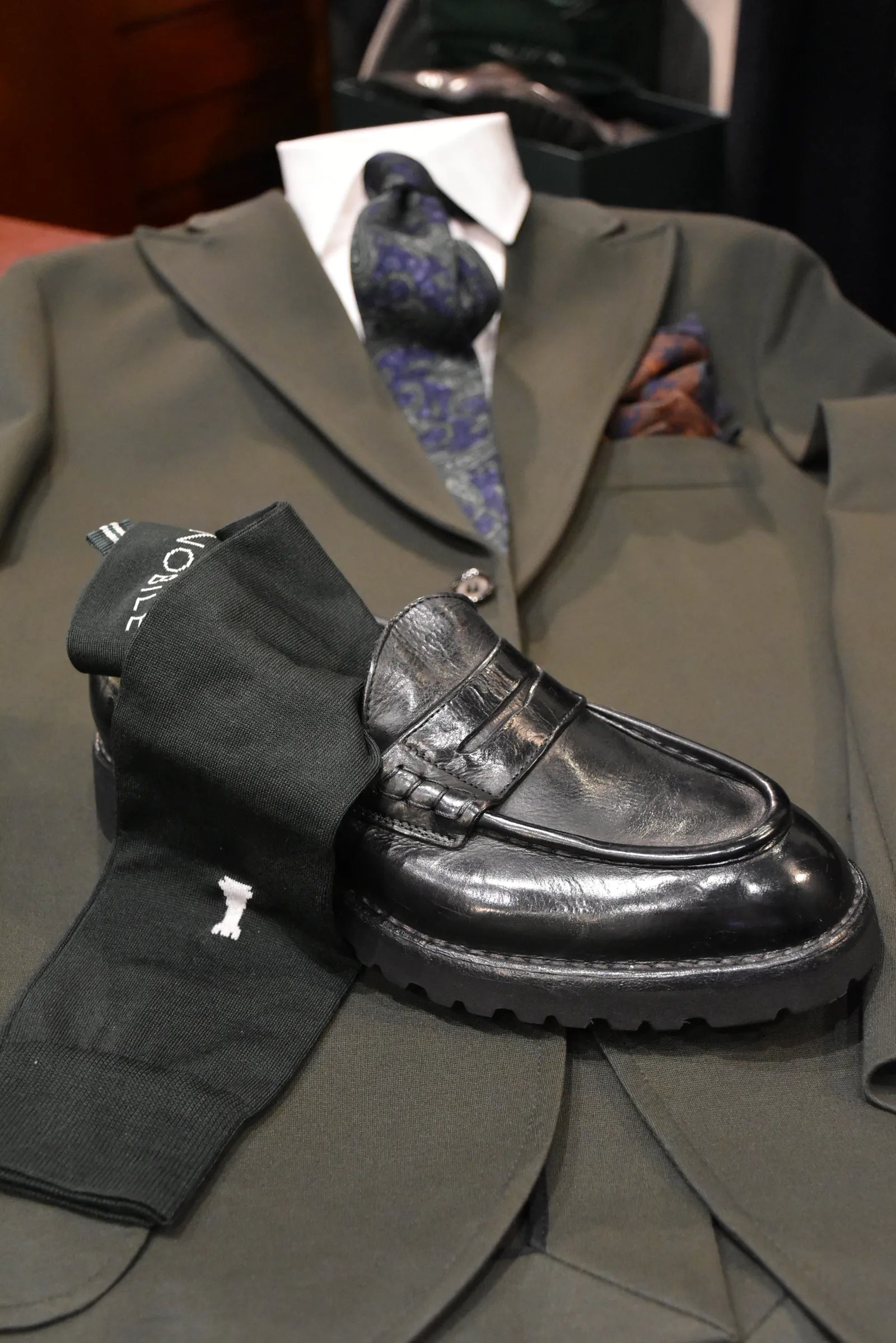
Warm Grays and Cream: The Neutrals That Hold It All
The season's bolder colours, burgundy, forest green, cognac, need room to breathe. That room comes from the neutrals. Not the cold, industrial greys we know, but a warmed-up version of them: taupe, smoke grey, cream and ivory. Their undertone leans toward beige and earth, which is why they sit so easily beside autumn and winter's warm shades.
Think of warm grey as a more refined canvas than usual. A backdrop where a strong accent stands out without shouting. A taupe knit under a navy jacket lets a burgundy sock come through with an ease that steel grey would stiffen. Green behaves the same way: against smoke-grey trousers, an olive note at the ankle looks intentional rather than accidental.
Cream works differently. It's the refined neutral for crew-neck knits, roll-necks and shirts, the one that softens looks built on close-toned colours. A head-to-toe brown outfit, from camel to chocolate, risks going flat; a cream shirt or knit opens it up, adds light and holds the shades together.
Ivory, a touch warmer than cream, does the same job with a further nudge toward the sartorial. Try an ivory roll-neck under a brown tweed jacket with smoke-grey flannel trousers: the three tones stay close yet never blur, and the whole gains depth instead of flattening out. It's the easiest way to make a low-saturation look feel rich without bringing in an actual colour.
If you're building an earthy look along these lines, start from the warm neutrals and check how to wear brown to balance the proportions between the shades.
Our socks in extra-long-staple Makò cotton and true Filoscozia® render exactly these greys and creams well: stable colour after many washes and a dry hand all day. To find your way among the tones, see how to choose sock colours.
The Accents: Deep Red and a Cold Blue, in Small Doses
Set a thread of deep red next to a burgundy and the gap is obvious in a second: the red runs warmer and sits far higher in saturation, it vibrates, it almost catches the light, while the wine tone stays muted, closed, leaning on brown. These aren't two shades of one colour, they're two different characters.
Deep red wants to be seen; burgundy would rather slip by unnoticed. Alongside the red, a cold, almost electric blue, with a digital edge that cuts straight through the amber warmth of the season and brings a note of right now.
One rule keeps them elegant: use them sparingly. An accent lives on a single detail and dies the moment it floods the whole look. One point of colour at a time, never two.
- deep red socks with a grey suit, for a Friday at the office
- a flash of cold blue in a scarf over a camel coat
- a knit beneath the jacket, glimpsed just below the lapel
- a pocket square, if everything else stays quiet
Take the first one. Go for a mid grey: a dark charcoal turns severe and smothers the red, while a lighter grey lets it breathe. Black shoes keep the whole thing crisp, brown softens the contrast. The sock appears between the hem and the lacing, and that glimpse is enough to set the tone.
Cold blue follows the same logic. Picture a camel coat, an ecru jumper, and an electric blue scarf knotted high at the neck: a single flash that lights up the look without shouting. Or the same note on a sock, if the scarf feels like too much.
Of all of them, the sock stays the ideal place to take the risk. It shows just enough when you cross your legs or walk, and stays a measured gesture. Above all it is reversible: if halfway through the day you decide it wasn't the right call, no one will remember your socks, while a red coat stays on you until the evening. A Nobile red on a Filoscozia® sock holds its colour wash after wash, saturated and alive, without drifting toward the faded pink of cheaper yarns.
Cold blue is at its best next to the warm neutrals: against camel and cognac the contrast turns sharp and modern. If you want to work through its registers, from classic navy to electric, we cover it in depth in how to pair blue for men. The rule stays the same: small doses, one accent at a time.
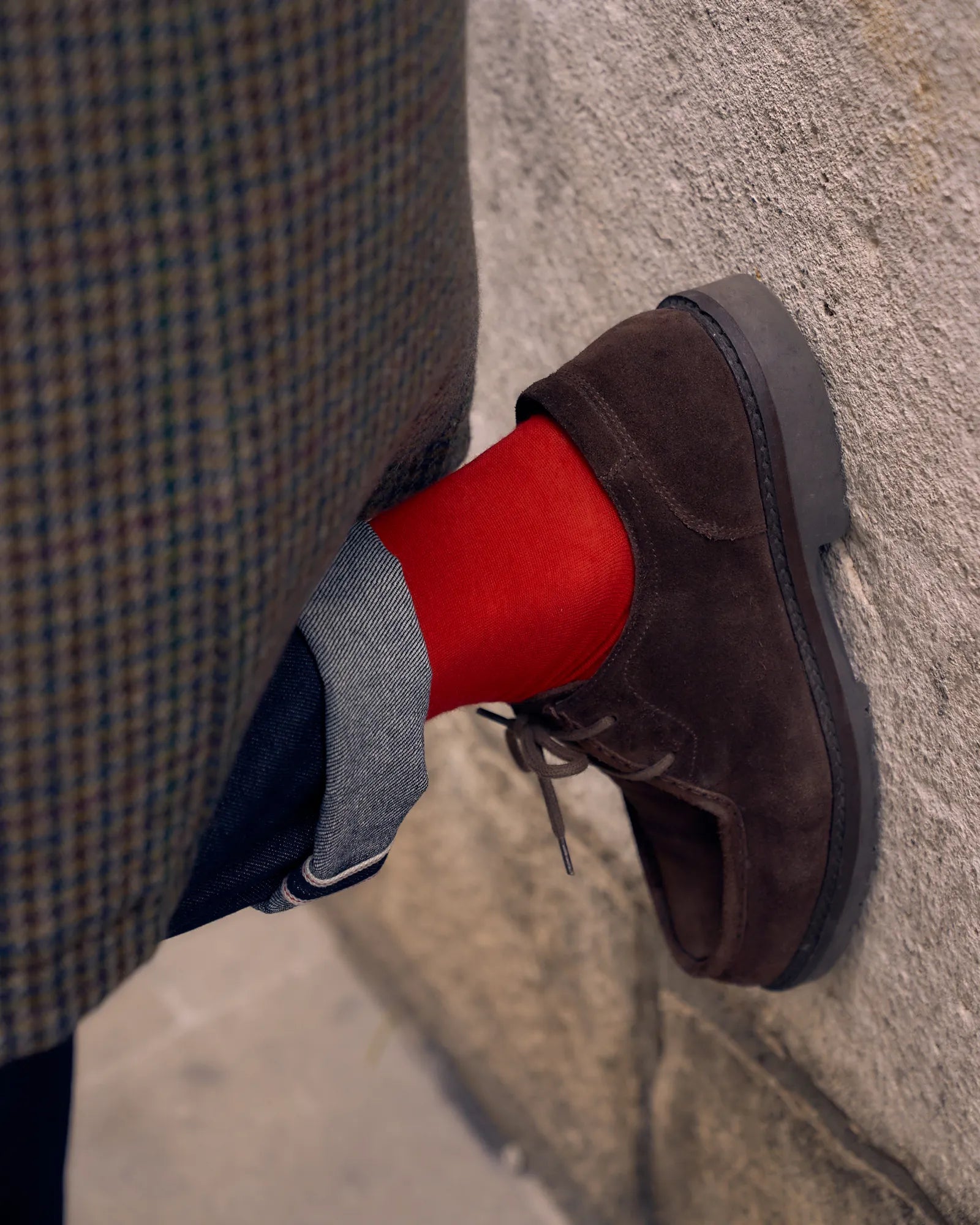
How to Build a Coherent Palette (a Simple Method)
A good outfit never comes from six colours competing for attention. It comes from a clear hierarchy. The most reliable method is still the 60/30/10 ratio: 60 percent is your neutral base, 30 percent the dominant seasonal colour, 10 percent a measured accent. For menswear, that gives you a clean order of reading, from the largest garment down to the smallest detail.
Start with the base. Pick just one between warm grey, camel and midnight blue: it is the colour of the piece that covers the most surface, usually the suit or coat. Then add the seasonal dominant, burgundy or forest green, on a mid-size element like a knit, cardigan or tie. Finish with the accent, which lives on a few inches: a pocket square, a scarf, or the sock.
On the sock, the practical rule is a choice between two routes:
- Tonal with the trousers: the sock matches the trouser colour, lengthening the leg and creating an unbroken line from knee to shoe. It is the most elegant, lowest-risk move.
- A controlled accent: the sock picks up a colour already in the look (the burgundy tie, the green in the knit), so the detail reads as deliberate rather than random.
Three ready-made formulas to copy, built to last the whole season:
- Warm grey suit, burgundy knit or tie, burgundy socks echoing the colour up top.
- Camel trousers, olive knit, forest green socks in dialogue with the knit.
- Midnight blue suit, cream shirt or roll-neck, blue socks tonal with the trousers.
The fabric matters as much as the colour. A sock in genuine Filoscozia® or Merino wool (80% Merino wool, 18% nylon, 2% elastan) holds its shade and shape through many washes, which counts when you build precise combinations you plan to repeat. For a full way to choose the accent, start with how to choose sock colours, then dig into how to pair burgundy and how to pair green.
Method
How to build a coherent palette for autumn and winter
Turn seasonal colours into a quick method you can apply every morning. Pick a base, add a dominant colour, finish with a measured accent.
What you need
-
1
Start from a neutral base
Pick the colour that fills roughly 60 per cent of the look: warm grey, camel or midnight blue. It's the canvas you work on. Trousers and jacket stay on this base, which forgives mistakes and holds everything together.
-
2
Add the dominant seasonal colour
Bring in a 30 per cent of bold autumnal colour: burgundy or forest green. Put it on a knit, shirt or pullover. It's the colour lead of the cold season, and it talks to the neutrals without fading out.
-
3
Finish with the 10 per cent accent
The last 10 per cent is the measured accent: a tie, a pocket square or the sock itself. This is where you choose tone on tone with the trousers to lengthen the figure, or a controlled accent that echoes another element already in the look.
-
4
Decide the role of the sock
Just two rules. Tone on tone with the trousers when you want a clean line and a longer leg. An accent when you pick up a colour already present above, so the sock looks chosen rather than left to chance.
Recommended product: Filoscozia® Collection
-
5
Copy one of the three formulas
Warm grey suit with a burgundy knit and burgundy socks, tone on tone. Camel with an olive shirt and forest-green socks. Midnight blue with a cream shirt and midnight-blue socks. Three outfits ready to go, all within the season's colours.
-
Expert tip
If you're going to get it wrong, get it wrong on the sock, not on the suit. A Filoscozia® sock in the right colour rescues a dull outfit in a second, while a suit off the palette stays a problem all day long.
Runway Colors vs the Colors You Actually Wear
Runways are built to overstate. A head-to-toe burgundy look reads beautifully under the lights and in photos, yet on a Monday morning at the office it turns heavy, almost like a costume. The real job isn't copying the exit from the show, it's deciding which colour idea to keep and where to place it in your own wardrobe.
The principle is simple: a runway trend, in real life, almost always lands as one small, well-chosen piece rather than a full volume of colour. The burgundy that walks as a coat and trousers becomes a tie, a sock, a scarf. The colour message survives, the excess disappears.
The same goes for the layering you see on the catwalk, where three or four tones stack up. In real life the 70/30 rule carries it: one colour owns about seventy per cent of the look, the other answers it with the remaining thirty. An olive knit under a grey jacket, with an olive sock echoing that green at floor level, has already done all the work and skipped the excess.
Here is how each key colour steps down from the show to daily life, with the exact piece to carry it:
The ideal piece to carry these colours safely is often the smallest one: the risk is low and the payoff is high. A coloured sock, for instance, works precisely because it stays quiet until you cross your legs. If you want the full picture across the season, start with the fall winter 2026 menswear trends and with how to choose sock colours.
From the runway to your wardrobe: how to actually wear it
| Key AI color 2026 | Runway version | Everyday version |
|---|---|---|
| Burgundy | Monochrome total look from jacket to trousers | A burgundy sock or tie over a navy or grey suit |
| Forest green | Oversized green coat from head to toe | Forest green socks under grey trousers, for dinner or the office |
| Camel | Layering of three warm tones stacked together | A camel sweater with light grey socks, two well-chosen tones |
| Midnight blue | Total-blue evening outfit with glossy details | A navy suit with tone-on-tone socks in Filoscozia® |
| Dove grey | Deconstructed tailoring in dusty hues | Dove grey socks tying trousers and shoes together on the move |
| Mustard | Bold warm-yellow accent across the whole outfit | A few centimetres of mustard: the sock you notice when you sit down |
Color in the Sock: Why the Yarn Changes Everything
Order the exact same burgundy in four different socks and you'll watch it shift four times. It isn't a flaw, it's the physics of the yarn: every fibre catches the light in its own way, so the color is already transformed before you even think about pairing it.
Genuine Filoscozia® gives burgundy a satin depth, a dense red that never drifts toward orange and stays refined under dinner-table lighting. Pair it with a charcoal grey suit: the sock adds warmth without stealing the scene.
The other noble yarns push that same color in different directions, and the reason lies in how each fibre handles light.
- Mulberry silk: the fibre has a smooth, almost triangular surface that creates specular reflection, meaning it bounces light back in one precise direction, the way a mirror would. That's what lifts the luminosity and gives the color a living vibrancy. A silk burgundy asks for a midnight-blue suit and an evening out, not the office.
- Merino wool (80% Merino wool, 18% nylon, 2% elastane): the opposite case. The fibre is covered in microscopic scales that scatter light in every direction, so the color reads matte and deep. Burgundy turns earthy, happy to sit beside a tweed or a brown flannel and warm up winter.
- Hircus cashmere: the ultra-fine, soft fibre drops the shade a notch and makes it more intimate. The color turns discreet, perfect over corduroy trousers on a cold day.
The reason this works the way it does sits upstream, in our sock factory in Racale, Salento. We knit on 240-needle machines for a tight gauge that returns pigment with real fullness, with slow hand-pressing and a quality check on every single pair. That's where a color stops being a spec sheet and becomes something you feel on your skin.
If you want to start from the right selection for the cold season, see men's socks for fall, and to get the tonal pairing right read how to choose sock colours.
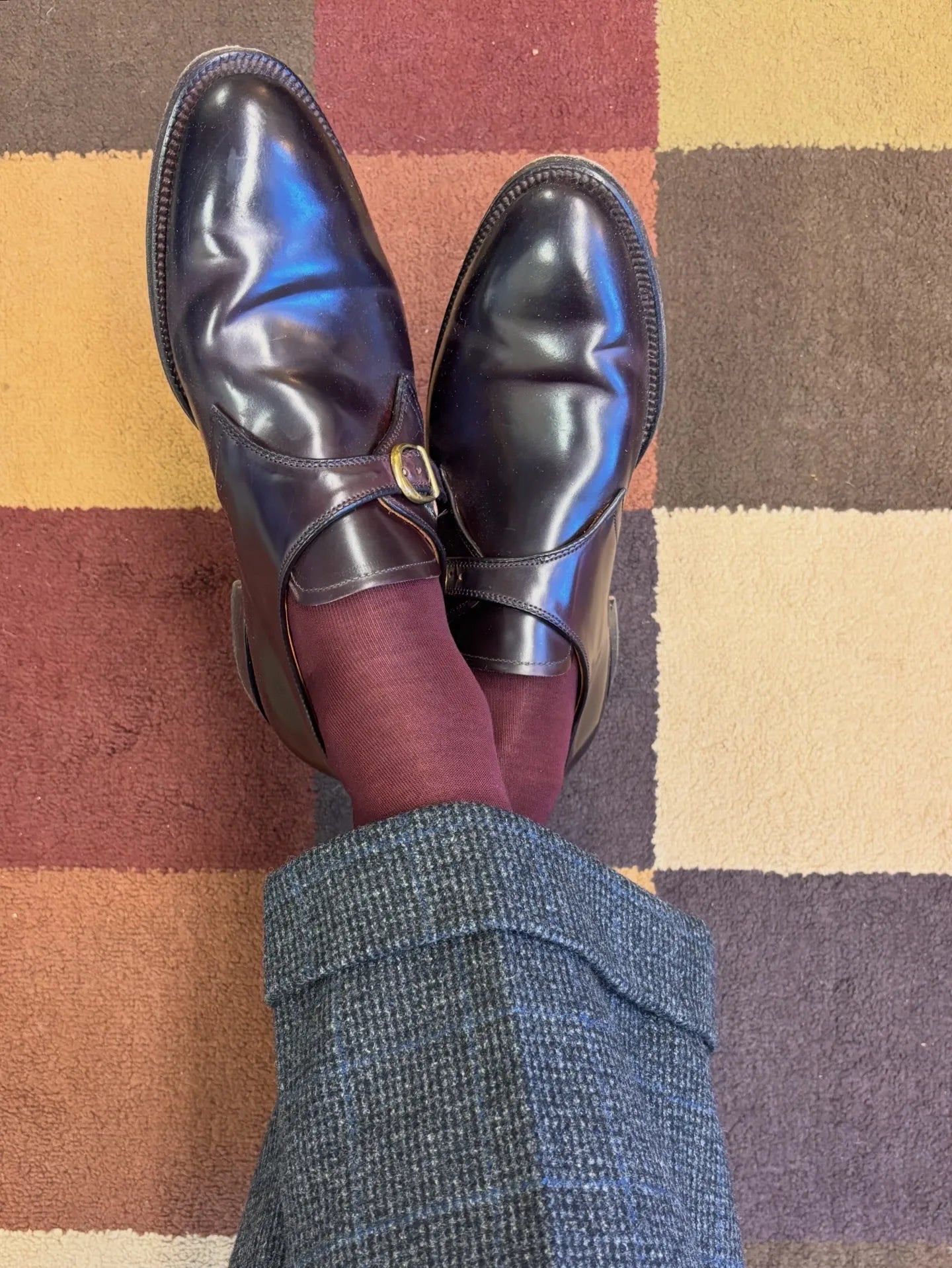
The same color, four different yarns
A burgundy never looks the same twice: depth, warmth and light shift with the fiber it's woven from. Here's how the noble yarns behave.
A two-ply yarn, mercerized and singed. It gives back a deep, satiny burgundy with a quiet luster that stays alive over time.
The fiber's natural crimp absorbs light and turns the tones warmer and more muted. A burgundy that reads softer and more enveloping, ideal under a winter suit.
A smooth fiber with no crimp: it reflects light evenly and brings out the brightness of the color. The same burgundy looks more vivid and radiant.
A very fine, soft fiber that gentles the color and smooths out contrasts. The burgundy turns more veiled and warm to the touch.
The higher the micron and the more pronounced the crimp, the more the yarn soaks up light and renders the color warm and muted; low microns and a smooth fiber give luminous colors. Two-ply Filoscozia guarantees durability: shape and color stay as they were on day one, wash after wash, while many famous-name socks felt and fade. It all starts in Racale, on 240-needle machines with slow hand-pressing.
Mistakes to Avoid with the Season's Colors
Color mistakes rarely show up in the mirror. They surface in photos or at the end of the evening. The good news: almost all of them come from two or three recurring habits, easy to fix once you spot them.
The first is stacking strong colors with no neutral base. Burgundy, forest green and rust together, all at the same intensity, turn a considered look into a collage. The working rule: one bright lead, the rest in warm neutrals (chocolate, caramel, stone grey). To get browns right, start with how to wear brown.
The second is the default black sock. On a warm palette, black cuts the visual link between shoe and trouser and flattens everything. Tobacco, dark brown or a deep grey work far better, as we explain in how to choose sock colours.
Three more common slips:
- Treating burgundy and bright red as the same. They run at different temperatures: one is dark and quiet, the other is an accent. Mixing them creates a jarring bounce. See how to pair burgundy.
- The shiny synthetic sock. One artificial glint at the ankle betrays hours of care spent on everything else. A matte, fine yarn (Filoscozia or Merino wool) stays discreet.
- Green in a sporty dose on formal wear. Military olive clashes with a dark suit; reach for a deep forest green instead. Details in how to pair green.
Finally, the subtlest one: ignoring texture. Three glossy fabrics together (silk, polished leather, synthetic sock) flatten the color even when the palette is right. Alternate one matte surface, one with grain, one soft.
A concrete example. Wrong: grey suit, white shirt, shiny black sock, brown shoe (grey + black + brown, three disconnected registers). Right: grey suit, cream shirt, matte tobacco sock, cognac shoe (grey + tobacco + cognac, one warm thread tying it all from ankle to shoe).

Why Nobile: Colors That Last, Yarns You Can See
A seasonal color is only worth having if it stays alive over time. The burgundy you picked in September should still read as burgundy in March, not a washed-out, tired red. That's the real line between a discount sock and a Nobile one: not the name on the label, but what happens to the pigment wash after wash.
Our socks are made in Racale, near Lecce, on machines with 240 needles that build a dense, even knit. The pressing is slow and done by hand, and every single pair goes through a quality check before it leaves. The supply chain is transparent: we know where the yarn comes from and where the sock ends up.
What really counts if you want a color that holds is simple: a fine yarn keeps its pigment wash after wash. It's not a label promise, it's the reason cognac stays cognac and forest green stays forest green, even after a full wardrobe of seasons.
The yarns matter too. True Filoscozia®, Mulberry silk, Hircus goat cashmere and Makò cotton don't fade like a cheap synthetic: they hold the color and give back the depth a seasonal color deserves. A quality a lesser yarn can't even imitate.
To get your bearings before you buy:
- Men's sizes M (EU 39-42), L (EU 43-46), XL (EU 47-50), with 35-38 on many models.
- Core colors always in stock: navy blue, black, grey, white.
- Custom sizing, larger or smaller than standard, available from a minimum of 6 pairs.
- 100-day trial with full refund: you actually wear them, not just read about them.
If you want a warm yarn that carries the deep tones of fall winter 2026, start with the men's socks made for the cold season, and if you're unsure about pairings, see how to choose sock colours that suit your wardrobe.
Choose your Merino wool socks now in the color you have in mind for fall winter 2026.
Frequently asked questions
What are the trending colors for fall winter 2026?
The men's palette revolves around burgundy, warm neutrals like chocolate, caramel and cognac, forest green and olive, plus warm grays and cream. Deep red and a cold blue work as accents, best used in small doses on a detail like the socks or pocket square. These are deep, wearable tones meant to last beyond a single season.
Is burgundy the same color as red?
No, burgundy is much deeper and darker, with a wine base that makes it behave more like a dark neutral than a bright red. That is exactly why it pairs easily and reads elegant without being loud. Keep it away from deep red: putting them together as if they were similar is one of the season's most common mistakes.
What colors go with burgundy for men?
Burgundy works beautifully with warm grays, navy, camel and chocolate browns. A burgundy sock finishes a gray or blue suit with refinement, ideally echoing the color of a tie or pocket square. Avoid pairing it with flat black, which tends to dull it.
Has brown really replaced black this year?
In this season's menswear, warm browns, from chocolate to cognac to camel, provide structure in place of black, which reads stiffer and less current. You build a tone-on-tone look by playing with different textures like flannel, corduroy and knit. The right sock becomes the bridge between trouser and shoe within this palette.
How do you wear green without looking too sporty?
The key is the right green, forest or deep olive, in a noble fabric with a tailored cut: a wool blazer in green over gray trousers reads elegant, not military. Use it as an alternative to blue for outerwear, and pair it with browns and burgundy for a coherent autumn triad. A green sock as a measured accent with a brown loafer rounds it off.
What sock color should I choose for fall winter 2026?
You have two routes: tone-on-tone with the trouser to lengthen the figure and keep things understated, or a controlled accent echoing another element like the tie or knit. Burgundy, forest green and cognac are the seasonal picks; gray and navy stay the wildcards under almost anything. The sock is the ideal place to risk color because it shows just enough and is easily reversible.
Can you actually wear runway colors every day?
Yes, but they need translating. A head-to-toe burgundy runway look becomes a burgundy tie or sock in real life; color layering becomes two well-chosen tones over a neutral base. The goal is to bring the trend into the office, to dinner or on a trip without looking like you're in costume, choosing the right item to place the color.
Why does a quality sock hold seasonal colors better?
Color renders and lasts according to the yarn: true Filoscozia gives a deep, satiny burgundy, Merino wool warm opaque winter tones, Mulberry silk luminous colors. A fine yarn and a dense knit hold their shape and color wash after wash, while many designer socks pill and fade quickly. That's the difference between a color that stays alive over time and one that dulls within weeks.