The first thing you notice as you pull on a cashmere sock isn't the warmth, it's the softness. The yarn glides over the foot without the scratch of classic wool, which often itches just above the ankle bone.
A synthetic sock doesn't itch, but after a few hours the foot sweats, and the cold creeps back in with the damp. Hircus goat cashmere warms you dry: it holds the heat without trapping moisture.
Anyone who has watched a prestige sock felt after two washes knows it: the raw fibre matters, but so does the way it is spun and finished. That is why Nobile Hircus goat cashmere socks are designed to leave no redness or irritation.
In this guide we cover what real cashmere in a sock is, how to tell it from a watered-down blend, when to wear it and how to make it last. If you are still weighing up different fibres, also read wool or cashmere socks: which to choose.
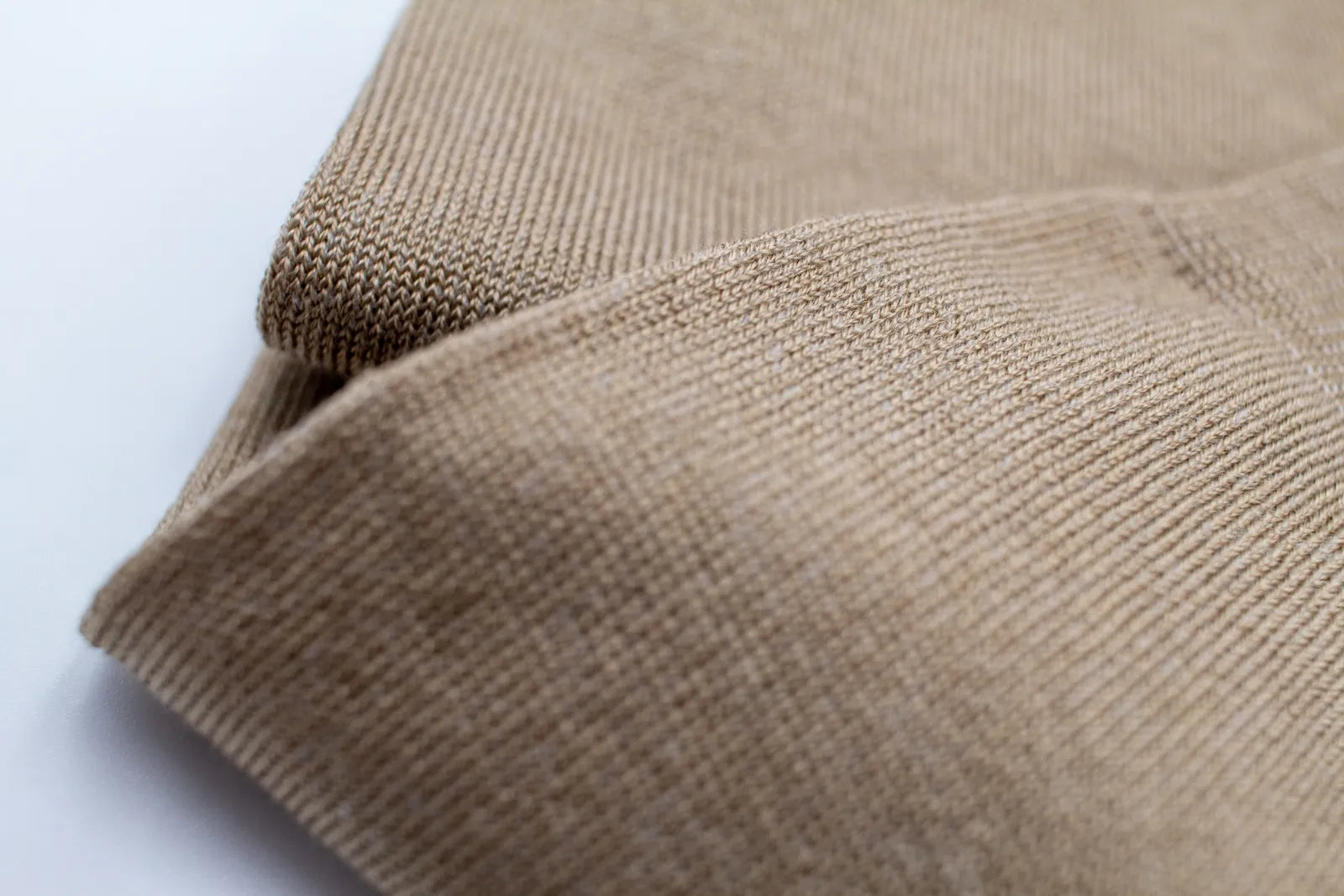
What Hircus goat cashmere is (and why not all cashmere is equal)
Fine cashmere is not the Hircus goat's outer wool. It is the duvet, the soft undercoat that shields the animal from the cold.
It is gathered in small amounts per animal, season after season, and that scarcity is where its value comes from. This is why such a delicate fibre ends up in the most expensive garments: there is little of it, and working it well takes skilled hands.
The catch is that the word "cashmere" also appears on labels where the noble fibre is a tiny share, drowned in cheap blends that borrow only the name. A yarn where cashmere genuinely leads is one thing; a product where it exists only to justify the price is another.
The most honest way to tell them apart is still to read the composition, not the marketing.
In Nobile Italy socks, Hircus laniger goat cashmere is 95%, joined by 3% Oeko-Tex® certified nylon and 2% Lycra®. That small technical share is no shortcut.
The nylon adds strength at the high-friction points, heel and toe, where pure cashmere would wear thin fast; the Lycra® holds the shape and keeps the leg up, so the sock doesn't slip down inside the shoe. A 100% cashmere sock, however seductive on the label, would be fragile and would tend to sag and lose its shape.
This is the logic of luxury you don't flaunt: no visible logo, but a yarn that leaves no redness or irritation on the skin. You'll find it in the real models, from the Nobile Luxury Essential (crew from 74.50 euro, knee-high from 84.50 euro) to the finer-knit Chiffon (84.50 to 94.50 euro), all made in Racale on 240-needle machines, one at a time.
To get your bearings among the noble fibres, here is a direct comparison on the points that matter when you choose a sock to wear all day.
If you want to dig into one of the columns, read up on the difference between wool and merino wool, or go straight to the Hircus goat cashmere socks.
Cashmere, Merino wool and Filoscozia® compared
Three noble yarns, three different ways of behaving on the foot. Here you compare them by fibre, warmth and breathability, sticking to the known technical data.
The fibre from the undercoat of the Hircus goat, gathered in small amounts per animal. Fine and short, warm and light, incredibly soft against the skin. On its own it would be fragile, which is why socks need a technical share of other fibres.
An extremely fine wool with a strong natural crimp, elastic and temperature-regulating. It keeps the foot dry and warm, tougher than cashmere but less silky to the touch.
Combed, mercerised cotton twisted in two plies, cool and luminous. High breathability, moderate warmth. The sheen and the hold come from the double twist.
The lower the micron value, the finer and softer the fibre. The crimp indicates elasticity and the ability to trap warm air. The two-ply symbol marks the twisted yarn.
Cashmere, Merino wool or Filoscozia: which sock for which need
Cashmere isn't the answer to everything, and it's fairer to say so. It's the right call when you want maximum warmth with minimum bulk: a sub-zero January morning, an evening event where the sock shouldn't crowd the shoe, a gift that reads luxurious by touch before you even look.
Hircus goat cashmere warms without squeezing and leaves no red marks on the calf, even after hours.
Merino wool does a better job when you need a sock that keeps pace. The Nobile blend of 80% Merino wool, 18% nylon, 2% elastan pushes temperature control further and keeps the foot dry through a long flight, winter sport, hard-wearing use five days out of seven.
It resists abrasion better than pure cashmere and holds its shape and colour wash after wash.
Filoscozia® is the pick for the mid-seasons. Ours is genuine certified Filoscozia®, long-staple cotton that is mercerised and gassed, two finishing steps that give it a smooth hand, a quiet sheen and real coolness: ideal under a spring suit or in a heated office, where you don't want heat building up.
To see at a glance where each fibre performs best, line up the criteria that actually matter when you pick a sock.
If you're torn between the two winter fibres, we go deeper into the comparison in wool or cashmere socks: which to choose, while the ready-to-wear models sit among the Hircus goat cashmere socks.
Cashmere, Merino wool or Filoscozia: how to choose the right sock
| Criterion | Cashmere Hircus | Merino wool (80% wool, 18% nylon, 2% elastane) |
|---|---|---|
| Warmth | Very high, soft insulation for the coldest days | High and steady, intense thermoregulation even under exertion |
| Softness on the skin | Extreme, 95% cashmere, leaves no redness or irritation | High, more structured and less silky than cashmere |
| Breathability | Excellent, light and breathable despite the warmth | Very good, handles sweat and moisture well during activity |
| Durability in use | Delicate, to be treated with care, ideal for select occasions | Sturdy, built for daily pace, sport and travel |
| Ideal season | Deep winter, intense cold, chilly evenings | Autumn and winter, everyday wear even under thermal stress |
| Occasion | Events, gifting, maximum comfort and a touch of luxury | Long days, training, work on the move |
How to recognize a genuine, quality cashmere sock
Cashmere is a word that sells, which is exactly why it gets used so loosely. A sock labelled vaguely as "cashmere blend" with no stated percentage tells you everything you need to know: if the content were high, you would see it printed in bold. The first move, always, is to read the composition label.
A serious sock declares its fibres with numbers.
There's a basic difference between a softness that impresses in the shop and one that survives the wash. Knit density is what matters when a sock has to keep its shape month after month, without stretching around the calf and without leaving a mark at the end of the day.
This is where the making comes in. In Racale, in the province of Lecce, we work on 240-needle machines, with slow hand finishing and a quality check on every single pair: these steps are what guarantee an even stitch and real durability. You can see the criteria at work in our models by browsing the Hircus goat cashmere socks, and if you're unsure which fibre suits you best, the comparison in wool or cashmere socks: which to choose can help.
Practical guide
How to spot a genuine, high-quality cashmere sock
Plenty of brands print "cashmere" on the label without saying how much is really there. Five quick checks tell you whether you're buying a fine yarn or just a promise on a tag.
What you'll need
-
1
Read the real percentage
Be wary of the wording "cashmere blend" with no numbers. A serious sock states the exact composition. Look for the percentage of every fibre: clear figures, not slogans.
Recommended product: Nobile Luxury Essential, Knee-High Sock in Hircus Goat Cashmere
-
2
Feel the hand of the yarn
Good cashmere feels soft and dry to the touch, never greasy or unnaturally shiny. If it prickles or seems coated in silicone, the yarn is poor or over-treated. True softness stays soft even after you rub it between your fingers.
-
3
Look at the density and regularity of the knit
Hold the stitch pattern up to the light. It should be tight, even, with no holes or dropped stitches. A dense, regular knit holds its shape over time and won't lose it on the first wear.
Recommended product: Chiffon, Fine Knit Knee-High Sock in Hircus Goat Cashmere
-
4
Check the technical share of nylon and Lycra
A small share of technical yarn has a purpose: it gives hold and stretch without altering the cashmere. A touch of nylon and Lycra, like our 3% and 2%, is a sign of smart design, not of cutting corners.
-
5
Check the seams and the toe
Run a finger over the toe: the finish should be flat, with no bulk that rubs. Clean seams and a well-closed toe point to real control over the product, not rushed workmanship.
-
Expert tip
Quality cashmere should never prickle or leave redness: softness protects the skin instead of irritating it. Our socks are made in Racale (LE) on 240 needles, with slow hand pressing and a check on every pair, so density and hold are a guarantee, not a gamble.
Nobile Italy's Hircus cashmere models
The cashmere collection starts from one clear decision: work only with Hircus goat cashmere (laniger), with the same blend across every model.
The detail that sets them apart on the skin is stated on the product pages themselves: these socks leave no redness and no irritation. At the end of the day, shoes off, the ankle shows none of the usual marks, something anyone who spends twelve hours on their feet or in meetings notices at once.
There are three colours, chosen for formal wardrobes and dark suits: blue, black and anthracite. Every model comes in a short and a long version, in a box of 6 or a box of 12, inside the Hircus cashmere sock collection.
The two souls of the line answer two different needs:
- Nobile Luxury Essential (knee-high €84,50, crew €74,50): more substance and more warmth. The knit has real body, ideal when you want genuine heat under closed shoes or boots, through the coldest months or on a long winter trip.
- Chiffon fine knit (knee-high €94,50, crew €84,50): thinner and more refined. The close knit disappears under the suit, slips into a narrow derby without bulk and stays discreet when you cross your legs at a gala dinner.
Choosing between crew and knee-high is simple. The knee-high reaches the calf and never leaves bare skin showing when you sit down: it's the suit version, and the one for a full day on your feet.
The crew is more versatile with smart-casual looks and slimmer trousers. If you tend to run hot, the crew helps release heat; if you want coverage and hold, go knee-high.
Sizes follow the real Nobile sock ranges: M for EU 39-42, L for EU 43-46, XL for EU 47-50. Anyone outside those ranges can request a made-to-measure size, larger or smaller, with a minimum of 6 pairs per model. If in doubt, check the size guide before you order.


How to pair cashmere socks without getting it wrong
Cashmere dislikes a loud contrast. It lives on tone-on-tone and restraint: the sock extends the line of the trouser and converses with the shoe rather than cutting it off.
Once you grasp this, you stop picking colours at random and start thinking in colour families, the way you would with a tie.
Three pairings work almost every time, and they are worth committing to memory. You will find them all in the real Hircus colours (blue, black, anthracite), in knee-high and crew lengths.
Length matters as much as colour. The knee-high cashmere sock (Nobile Luxury Essential at 84.50 €) sits below the knee and solves the most visible problem once you sit down: no bare ankle when you cross your legs.
The crew sock (74.50 €) is at its best with a loafer, keeping the foot warm and dry without bulking up the ankle.
The winter office
Grey suit, anthracite knee-high, black derby: the line stays unbroken even through a seated meeting, the moment when a flash of bare skin would betray a rushed morning.
Dinner
Dark suit or dinner suit, smooth black like the fine-knit Chiffon models, polished black lace-ups. Here the sock should vanish under the hem and leave the suit the stage: the soft hand of cashmere adds comfort for a long evening without a single showy note.
A weekend in the mountains
Flannel, navy crew, tan leather loafers. Warm and dry, with a relaxed but considered register, ideal for a day out without giving up on style.
Two practical habits: match the sock to the trouser, not the shoe, except for an all-black look; and favour a deep solid colour over a flashy print.
You will find these shades among the Hircus goat cashmere socks, and for a side-by-side on the fibres read wool or cashmere socks: which to choose.
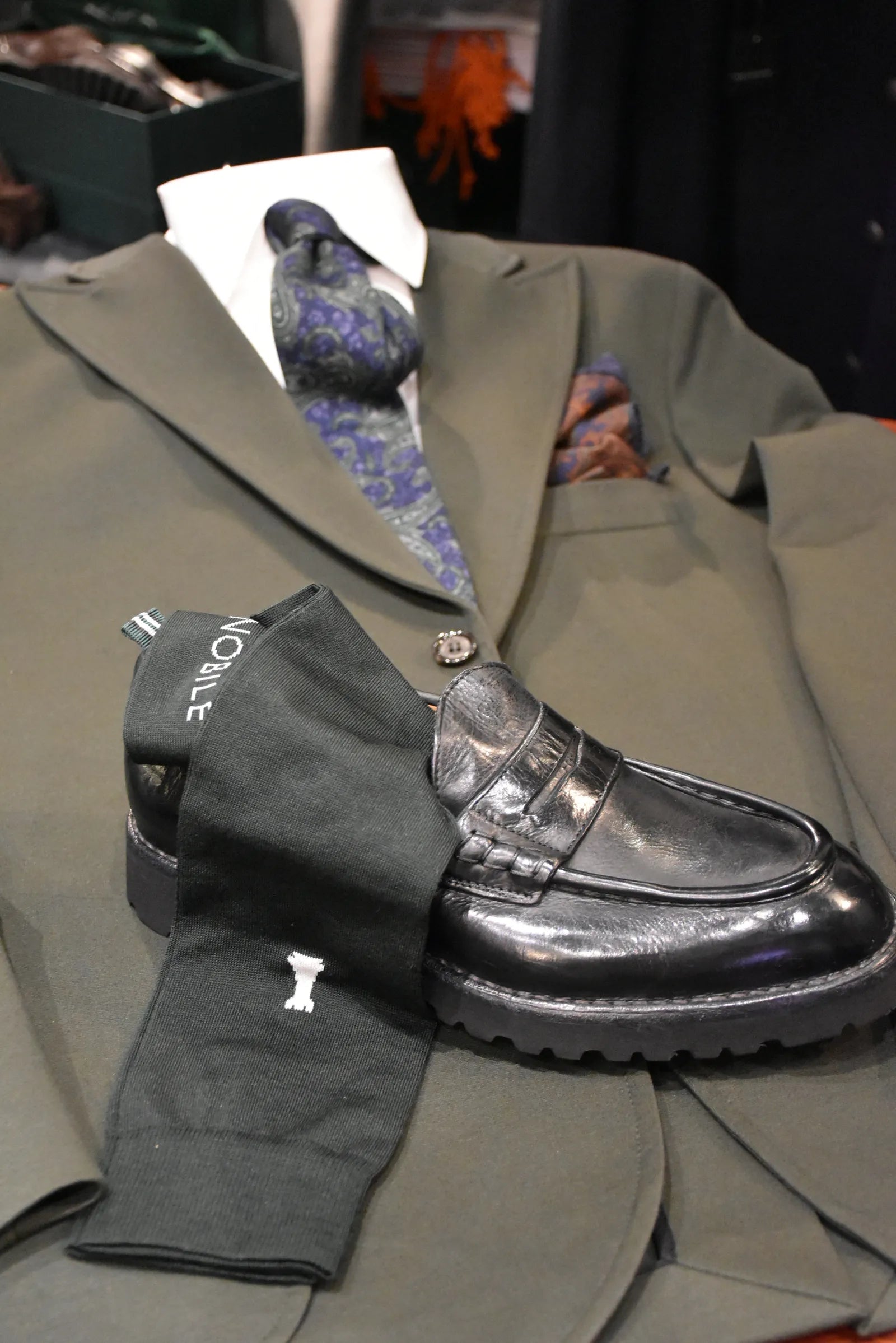
How to style men's cashmere socks
Tone on tone and restraint: the sock follows the suit, never the other way round. Go knee-high so you don't bare an ankle when seated, crew-length cashmere with loafers in the cold months.
the winter office wildcard
dinner and quiet elegance
black tie and formal evening
When to wear them: seasons, occasions, travel
Hircus goat cashmere warms differently from ordinary wool. It gives a dry, enveloping warmth, without that overheated feeling that makes you want to slip a shoe off under the table.
The fibre regulates temperature and keeps the foot dry even after hours, because it absorbs moisture instead of trapping it against the skin.
Cashmere warms naturally, while the small share of nylon and Lycra® keeps the sock in shape and snug, so it never slides down inside the shoe.
That makes it the right call from late September to early March, but travel is where it truly proves itself. That is when temperature control matters most, because conditions keep shifting and the foot stays shut inside the shoe for hours.
Take a ten-hour work trip. You set off in the cold early air, then comes the wait at the gate, the pressurised cabin where your feet are the first to go cold, the dry heat of a taxi, and finally a meeting room with the air conditioning running even in winter.
Through all of it the cashmere does the work on its own: it holds the foot at a steady temperature when the surroundings are cold, and lets it breathe when the room warms up, so the sock stays dry from the first hour to the last.
You feel the difference by the end of the day. No damp foot after the flight, no chill creeping up from the sole when you sit for a long stretch, no reaching for relief by slipping a shoe off under the desk.
There is an honest caveat. Cashmere is not the right yarn for everything. An hour of running or an intense gym session push it too far, because the foot sweats heavily and you need a fibre built for that load; and at the height of summer cashmere is simply too much.
In those cases the answer lies between Filoscozia® or merino wool for the cold.
For the cashmere models themselves, from the Luxury Essential to the fine-knit Chiffon, you will find everything among the Hircus goat cashmere socks.
How to wash cashmere socks without ruining them
The most common disappointment with cashmere comes fast: a designer sock that shrinks after two washes, loses its softness and turns rough to the touch. That isn't bad luck, it's felting.
Cashmere fibres have microscopic scales that open under the combined effect of heat, mechanical movement and friction, then lock into each other for good. The knit tightens, shortens and hardens.
Avoiding it is simple: just remove those three triggers from the wash.
Cashmere well cared for
- Stays soft and silky to the touch
- Holds its length and fit
- Cuff that leaves no mark
- Full, even colour
Felted cashmere
- Rough, compacted surface
- Shrinks and grips the foot
- Slack or warped elastic
- Dull, patchy colour
One habit makes a real difference in the long run: rotation. Alternating several pairs rather than wearing the same one over and over gives each sock time to recover its shape between uses, easing the strain on fibre and cuff.
Packing for a trip, two or three pairs will carry you through a week without ever overworking a single one.
Storage matters too: keep your socks folded, not stretched or tightly rolled, so the elastic cuff stays elastic and doesn't give out.
The small share of nylon and Lycra® adds structure and hold, so they resist felting better than a 100% cashmere yarn. And if something doesn't convince you, the 100-day trial with a full refund gives you the room to put them through their paces, washes included.
Cashmere care
Cashmere felts because of heat, agitation and friction. A few right moves keep your socks soft and intact, even after many washes.
-
1
Understand why it felts
Felting comes from three factors meeting at once: heat, mechanical movement and friction. Cashmere fibres open up and tangle irreversibly. Avoid those three and you avoid felting.
Recommended product: Nobile Luxury Essential, Knee-High Socks in Cashmere di capra Hircus
-
2
Turn the sock inside out before washing
Flip the sock inside out to protect the outer surface from friction. This also reduces pilling on the visible side.
-
3
Wash by hand or on a cold wool cycle
Use cold water, 30 degrees at most. If you go for the machine, set a gentle wool cycle with minimal or no spin. Slow movement and low temperature keep the fibres closed.
-
4
Neutral detergent, no harsh fabric softener
Pick a detergent made for wool or a gentle neutral soap. Keep away from bleach, stain removers and harsh softeners that weaken the fibre. Use little product and dissolve it well in the water.
-
5
Never twist, never wring
Never wring wet cashmere: twisting breaks the fibres and distorts the knit. Press it gently between your hands to squeeze out excess water, then roll the socks in a towel and blot.
-
6
Dry flat, away from heat
Lay the socks flat on a surface, never hung up where they stretch out. Keep them away from radiators, direct sun and the tumble dryer. Heat is cashmere's main enemy.
-
Expert tip
Our Hircus goat cashmere is made to last: with these habits it stays soft for a long time. And if something doesn't convince you, you have 100 days to try it with a full refund.
Mistakes to avoid when choosing cashmere socks
Cashmere rewards anyone who chooses it with a little care and punishes the impulse buyer. A handful of recurring mistakes spoil the experience before the sock even reaches your foot.
Here they are, each with the practical fix alongside.
- Letting a low price make the decision. Cashmere that's too cheap almost always carries a minimal share of noble fibre, sometimes two or three percent, with the rest acrylic in disguise. It barely warms, it pills within days, and one winter finishes it off. Far better to spend once on a sock that lasts.
- Ignoring the real percentage on the label. The word cashmere on the packaging means nothing without the numbers beside it. Always look for the exact composition, fibre by fibre. If the percentage is missing, that's a warning sign.
Then there's the opposite mistake, less obvious: assuming 100% cashmere is automatically the best choice. It can be for a scarf, but not for a sock.
Without a small share of technical fibre the sock wears through at the heel in weeks and slides down inside the shoe with every step. That small share of nylon and Lycra® is precisely what holds shape, strength and fit together. For a clearer look at how the fibres differ, see the difference between wool and merino wool.
Sizing often goes wrong out of conviction: cashmere will give, won't it. Cashmere isn't just any stretchy wool, it's soft but it doesn't lengthen on demand, so a tight sock presses on the instep and a loose one folds under the shoe.
Pick the right EU range from the start, say M for 39-42 or L for 43-46, and check it against the size guide.
Two final details decide how they age. Don't wash them like ordinary socks: no harsh spin, no tumble dryer, cold water and inside out, and they'll see out season after season.
And don't get the colour wrong for how you'll mainly wear them: navy, black and anthracite sit easily with tailored suits and casual looks alike. To find the right model, start with the Hircus goat cashmere socks.

Why Nobile cashmere is made in Racale, one pair at a time
Cashmere is a magnificent, temperamental fibre. It's fine, short and delicate, and worked carelessly it gives you socks that pill, loosen at the ankle or lose their shape after a few wearings.
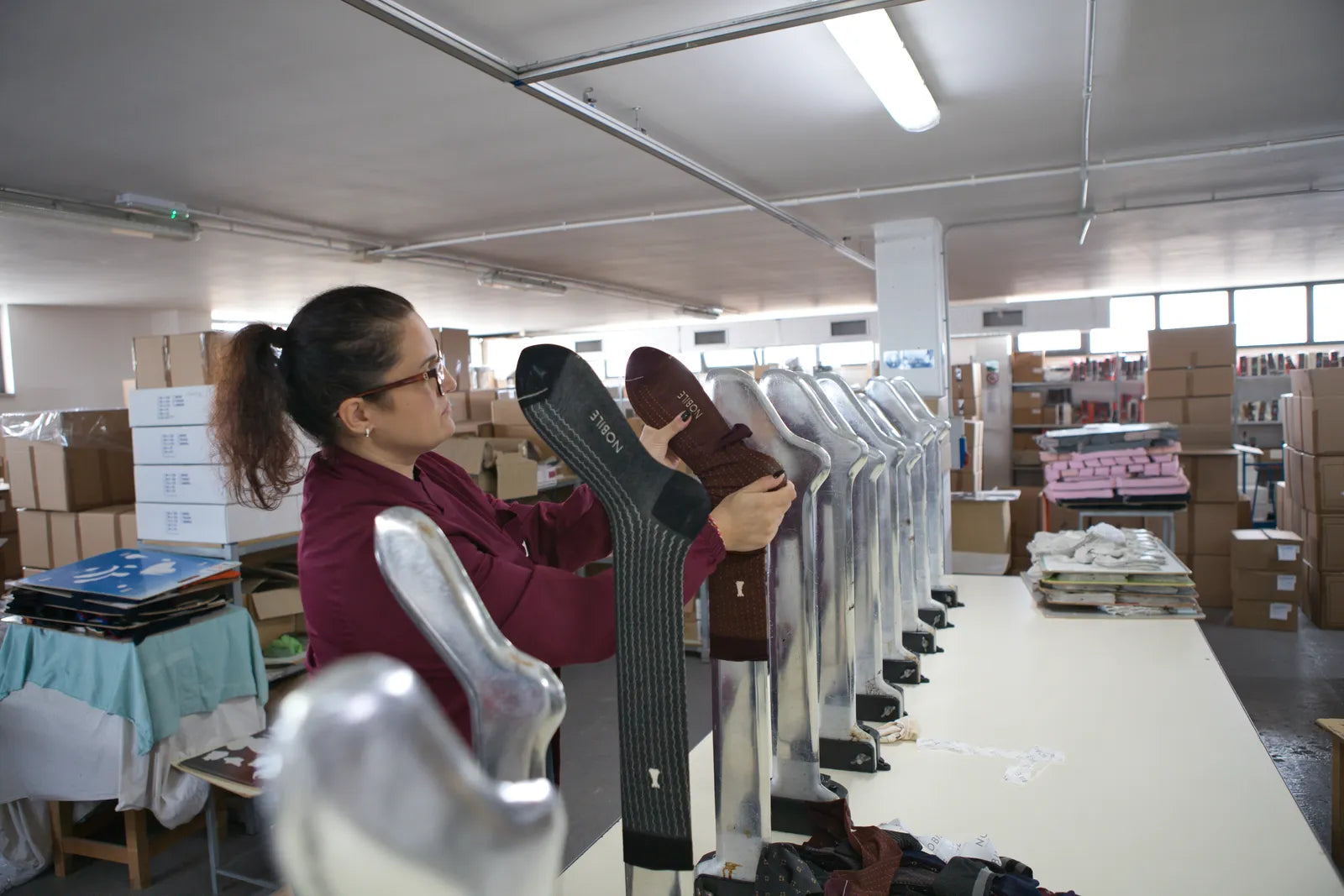
That's why Nobile keeps it in house: the Hircus goat cashmere socks are made in Racale, in the province of Lecce, where every step stays under control.
At the heart of it sit the 240-needle machines. More needles mean a tighter, more regular knit, and on a fibre as soft as cashmere that changes everything.
A dense knit holds the fibre better, reduces the tendency to felt, and gives the sock a structure that keeps its shape instead of collapsing halfway up the calf.
That density has a practical effect you feel at your feet:
- the sock stays up all day, with no need to hitch it back up mid-meeting;
- the fabric spreads weight and pressure evenly, with no points that leave a mark;
- the soft hand of the cashmere lasts, because the fibre isn't stressed by a loose, open knit.
After the knitting comes slow hand pressing, pair by pair. It isn't a flourish: this is where the sock takes its final shape and the yarn is checked for even tension.
Every single pair then goes through quality control, because a fibre this fine leaves no room for shortcuts.
The raw fibre does the rest: Hircus goat cashmere, chosen for its balance of warmth, lightness and shape. No logo on show, no theatre. Real quality, simply there to wear.
If you want to see it for yourself, take a look at the Nobile luxury sock collection: the short Nobile Luxury Essential starts at 74.50 euro, with boxes of 6 and 12.
A good way to understand, from the first wearing, what changes when cashmere is worked the way it should be.
Glossary
- Cashmere: a prized fibre taken from the undercoat of certain goats, valued for warmth and lightness.
- Duvet: the fine, soft undercoat of the goat, the noble part from which cashmere is drawn.
- Hircus: the goat (Capra hircus laniger) that provides the cashmere Nobile uses.
- Felting: the matting of fibres that compacts and stiffens the fabric, to be avoided with correct washing.
- Oeko-Tex®: a certification confirming the absence of harmful substances in the yarn.
- 240 needles: the gauge of the knitting machine, a marker of a dense, regular knit.
- Fine knit: a tight-stitch construction that gives the fabric lightness and definition.
Frequently asked questions
Do cashmere socks really keep you warm?
Yes. Hircus goat cashmere delivers a dry, enveloping warmth without making the foot sweat, because it breathes and regulates temperature. Unlike many coarser wools it doesn't itch or leave redness. It's the right choice for cold days and chilly air-conditioned settings, from a winter wedding to a long flight.
Why aren't cashmere socks 100% cashmere?
A sock made of pure cashmere alone would be fragile, wear through quickly and tend to slide down. That's why a small technical share of other fibres is added: ours are 95% Hircus laniger goat cashmere, 3% Oeko-Tex certified nylon and 2% Lycra, just enough for durability and shape retention without losing softness. It's a functional choice, not a cost-cutting one.
How do you wash cashmere socks without ruining them?
Wash them by hand or on a cold wool cycle, or at 30°C maximum, with a gentle neutral detergent and no harsh softeners. Don't wring them, don't tumble dry, and dry them flat away from heat. Cashmere felts with heat, agitation and friction, so a few careful habits are enough to make it last.
What's the difference between cashmere and Merino wool socks?
Cashmere is softer, lighter and more refined, ideal for comfort and special occasions; Merino wool is sturdier and regulates temperature more intensely, better suited to everyday winter wear and sport. Cashmere leans into refinement, Merino into functional durability. The right pick depends on how you'll mainly use them.
How do I recognize quality cashmere in a sock?
Check the actual cashmere percentage on the label and be wary of vague wording with no numbers. To the touch, good cashmere feels soft and dry rather than slick, and never scratches the skin. Look too at the density and regularity of the knit and the finishing at the toe: a tight construction, like a 240-needle knit, signals both durability and comfort.
Can I wear cashmere socks with loafers?
Yes. The crew-length cashmere works beautifully with loafers in the colder months, in anthracite, navy or black to match your outfit. For a more formal look under a suit, choose the knee-high version, which keeps the ankle covered when you sit. Go tonal for an understated, elegant effect.
Are cashmere socks a good gift?
They make a refined gift that combines quiet luxury with real usefulness: softness, warmth and a well-chosen detail that gets noticed. Boxes of 6 or 12 pairs, plus understated colours like navy, black and anthracite, make them a safe choice. It's the kind of present the recipient actually uses every day through the cold season.
What size of cashmere socks should I choose?
Our sizes follow the real EU ranges: M 39-42, L 43-46 and XL 47-50. Choose by shoe size and don't count on cashmere stretching, since it isn't just any elastic wool: the right size fits well straight away. If you need sizes outside the standard range, you can order a made-to-measure size with a minimum of 6 pairs.