End of the day, you take off your shoe and there it is: a red groove pressed into your calf. Or you feel the sock slip under your heel and bunch up inside the shoe during a meeting.
Two different annoyances, one shared cause: the wrong size.
The right size isn't just your shoe number. Foot length matters, but so does the circumference of your ankle and calf, which decides whether the cuff pinches or the knee-high stays up.
Two people who both wear a 43 can need different socks: a slim foot and a broad one call for a different fit.
That's why this guide goes beyond the usual "measure your foot." Inside you'll find the EU-UK-US conversion table, the old Italian sizing system, no-show measurements, the men's and women's differences, the made-to-measure option and the common mistakes.
One useful note: Nobile works with precise EU ranges, not vague numbers. M covers 39-42, L covers 43-46, XL covers 47-50 (many styles also offer 35-38).
Knowing your range is the first step toward a sock that stays soft, dry after ten hours and free of marks by evening.
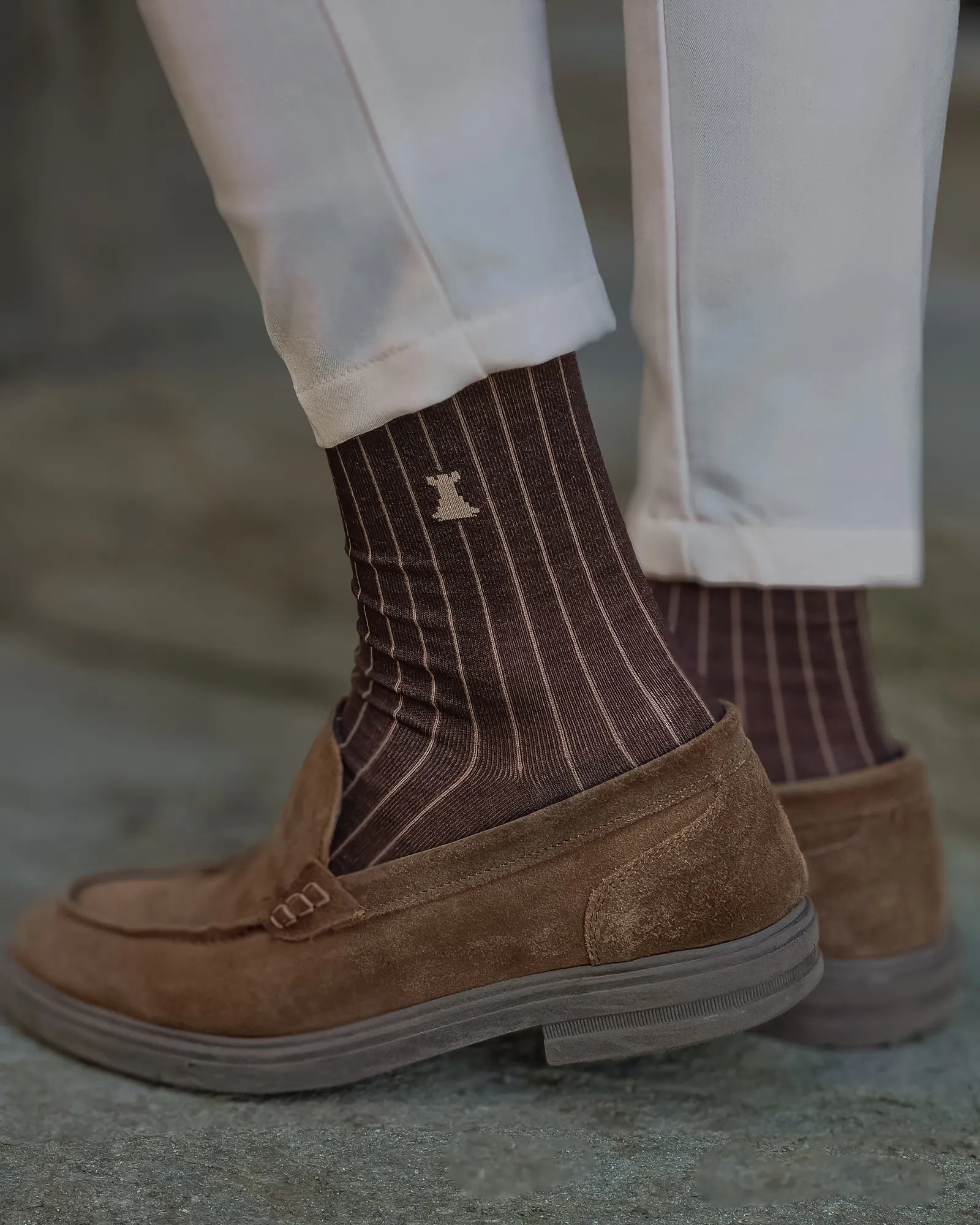
How Sock Size Is Actually Measured
A sock that fits well comes down to two numbers. The first is foot length, measured in centimetres from the tip of your big toe to the back of your heel.
The second matters only for knee-high socks: the calf circumference at its widest point. The EU shoe number is a shortcut, but your actual foot measurement is more reliable.
Measuring your foot in cm
It takes five minutes and three things you already own. Do it at the end of the day and measure standing, with your weight on the foot.
- Place a sheet of paper against the skirting board and stand on it, heel to the wall.
- Holding a pencil upright, mark where your big toe reaches.
- Measure from the edge of the paper to the mark: that's your figure in centimetres.
- Repeat with the other foot and go with the longer one.
As a reference, a foot of around 26 cm sits comfortably in the EU 39-42 range, which in our sizing is size M.
Why one size covers a range of numbers
A size isn't tied to a single shoe number but to a range (for us, M covers EU 39-42), because elastic knit adapts. This lets the yarn do its job.
A well-sized sock should never be stretched to its limit. Fabric pulled to the edge of its elasticity loses softness, thins out and gives way sooner.
With a little margin, the knit stays elastic, holds its shape and leaves no mark on the calf.
This is where the making matters. Our socks are produced in Racale, in Salento, on 240-needle machines: a high density that gives a tighter, more even fabric.
The result is a fit that follows the foot and a hold that won't slip, even after hours on your feet.
Practical guide
How to measure your true sock size
Two numbers matter more than your shoe size: foot length in centimeters and, for knee-high socks, calf circumference. With a tape measure and a sheet of paper, five minutes at home are enough.
What you need
-
1
Place the sheet against the wall with your heel at the edge
Put an A4 sheet on the floor against the skirting board. Stand with your heel to the wall, weight evenly spread. Measuring while seated skews the result, because the foot lengthens under load.
Recommended product: Nobile Essential, Solid Crew Socks
-
2
Mark the longest toe and measure in centimeters
With the pencil, draw a line in front of your longest toe (not always the big one). Measure the distance from the wall to the line with the tape. That is your real foot length in cm.
-
3
Compare against the EU range, not the old numbering
Each sock covers a range (M = EU 39-42, L = EU 43-46, XL = EU 47-50) because the elastic knit adapts to several sizes. The old Italian numbering (10, 11, 12) is only a rough guide and shifts by about half a size between makers.
-
4
For knee-high socks, measure the calf too
Wrap the tape around the widest point of your calf, without tightening. This number drives the hold: a well-sized knee-high stays up without leaving a red mark at the end of the day.
-
5
Never pick a size stretched to its limit
Yarn performs best with a little stretch to spare. If the knit is already taut when new, it loses shape faster. The 240-needle density of our sock factory in Racale (LE) improves fit and hold precisely because it spreads the weave more evenly.
-
Expert tip
Measure your foot at the end of the day, when it is slightly more swollen: that way you avoid buying a size that is too snug. If you are between two ranges, go for the larger one: the knit adapts, but it should never work at its limit.
Men's Sock Size Chart: EU, UK and US
Nobile sizing centres on three main sizes, built to fit most feet. Each covers a range of shoe sizes, so you can start from the size you wear every day.
Here's how the ranges read, with the British and American equivalents:
- Size M: EU 39-42 (UK 5.5-8.5, US 6.5-9.5)
- Size L: EU 43-46 (UK 9-11.5, US 10-12.5)
- Size XL: EU 47-50 (UK 12-14, US 13-15)
Many models also offer the 35-38 size, handy for smaller feet or for a closer fit with no bunching at the ankle.
Reading the chart is simple: find your European shoe size and pick the range that contains it. A 44 lands in the L, a 42 in the M.
The UK and US columns help with shoes bought abroad: just line up with the right row.
The question arises when your number sits at the edge of a range, a classic case for a 42 or a 43. Choose the size that contains your shoe size: a 42 belongs in the M, a 43 in the L.
If you're torn between two close sizes, or have a fuller calf, go for the larger one. A roomier sock rests better, doesn't pinch, and with the covered elastic band it stays up all day.
A touch of ease beats a stretched sock that slips during a meeting.
For feet outside the standard ranges, there's the made-to-measure size, available with a minimum of 6 pairs per model or pattern. It's how you get an exact fit when catalogue sizes don't cover you.
Nobile men's sock size chart: EU, UK and US
| Nobile Size | EU | UK / US |
|---|---|---|
| 35-38 (on many models) | EU 35-38 | UK 2.5-5 / US 3.5-6 |
| M | EU 39-42 | UK 5.5-8.5 / US 6.5-9.5 |
| L | EU 43-46 | UK 9-11.5 / US 10-12.5 |
| XL | EU 47-50 | UK 12-14 / US 13-15 |
| Shoe size falling between two sizes | Pick the one that includes your shoe size | If you're at the top of a range, go for the larger size for a comfier fit around the calf |
The Old Italian Sock Numbering: 10, 11, 12
Anyone who bought socks in the old traditional shops, with wooden drawers and a clerk asking "what size do you take?", remembers those round numbers: 10, 11, 12.
For decades this system guided sock buying in Italy, and many still look for it out of habit.
The catch is that it doesn't match the European shoe size. It refers to an internal measurement of the sock itself.
Worse, it was never fully standardised: from one maker to another it could shift by half a size. Always read it as a rough guide, never a precise figure.
How to convert the old size into the EU number
If you have an old size in mind and want the matching shoe number, this is the most commonly used approximate correspondence:
- 10 about shoe 39-40
- 10½ about 40-41
- 11 about 41-42
- 11½ about 42-43
- 12 about 43-44
- 12½ about 44-45
It bears repeating: these conversions can drift by about half a size depending on the maker.
If you took an 11 but your shoes ran large, your foot today is probably more comfortable nearer a 42.
At Nobile we don't use the old numbering. We work in European shoe-size ranges: size M covers 39-42, L covers 43-46, XL covers 47-50.
It's a clearer system, because it starts from the figure you know best: the shoe size you wear every day.
To move from an old size to ours, there's one reliable route. First convert into a European shoe number, then pick the Nobile range that contains it.
Keep the rule in mind: a 42 falls into M (39-42), while 43 moves up to L (43-46). The old 11½ sits around shoe 42-43, right on the line.
If your shoe is a 42, choose M; if it's a 43, choose L. The 100-day trial gives you time to check at home.
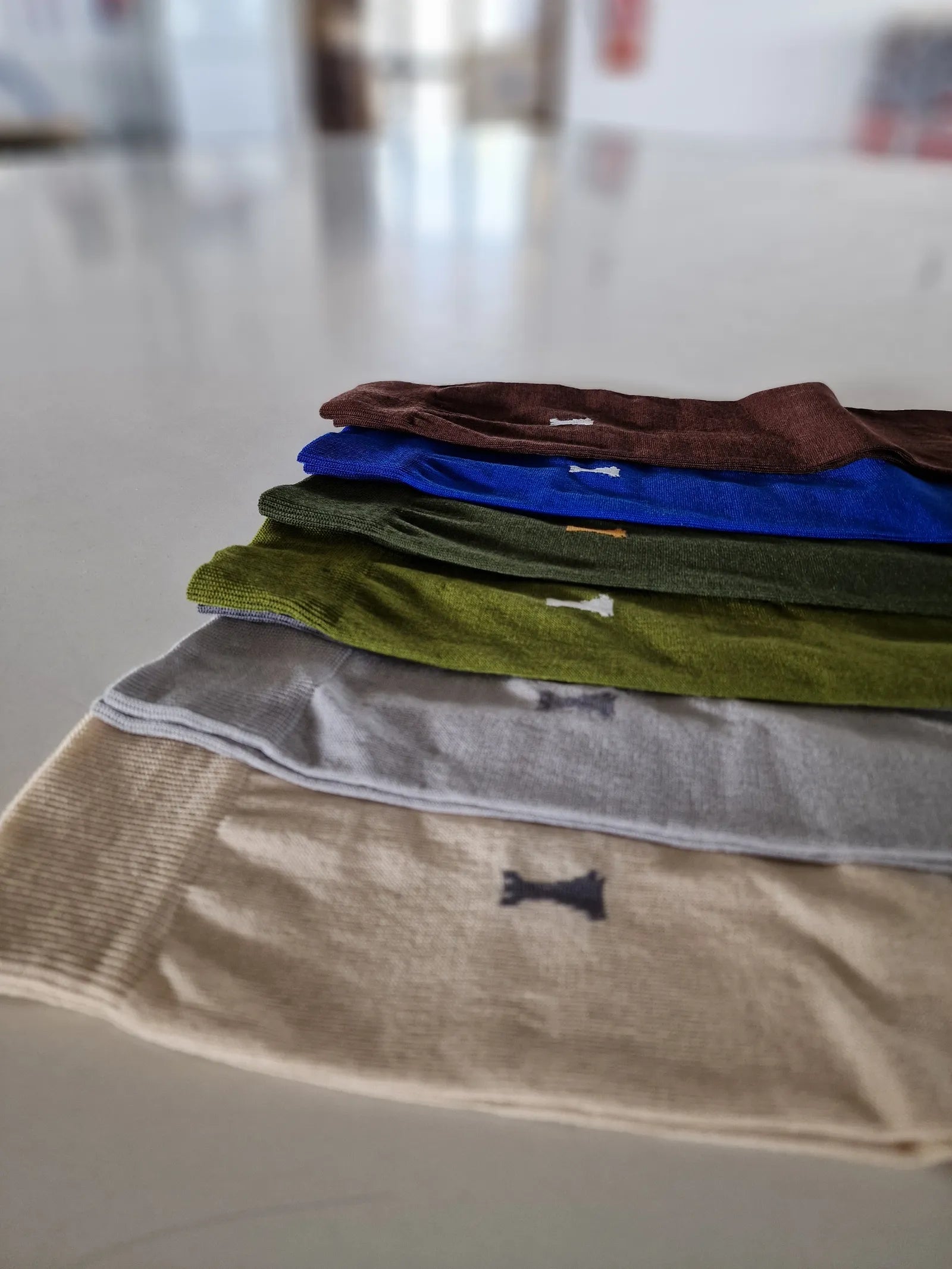
No-Show Sock Sizes: Why They're Different
No-show socks run on their own sizing, tighter than crew socks. Four brackets: 37-39, 40-42, 43-45 and 46-48.
No M, L or XL here, just your shoe number. The room for error is far smaller.
The reason is simple. A no-show has to disappear inside the shoe while staying locked onto the foot, with no edge peeking over the vamp.
Size up and the fabric slips with every step, until the heel escapes and the sock bunches under the ball of your foot. A bare foot, discomfort, and the urge to stop and fix it.
That's why the size of a no-show matters more than a regular sock. A no-show that slides down defeats its entire purpose: to stay unseen.
The difference shows most with loafers and smart sneakers, the low-cut shoes no-shows were designed for.
Wear a leather loafer in summer and you want a clean ankle, no bare skin, no fabric edge giving the sock away. With the right size, a no-show works quietly all day.
The practical rule is a single one, and it always holds:
- Pick the bracket that contains your exact shoe number, without rounding up.
- A 42 means 40-42, not 43-45: the larger one feels fine standing still but slips the moment you walk.
- Between two brackets, the smaller one wins: the knit stretches up but can't tighten down.
Nobile no-show socks are built for this balance: a shaped heel, a silicone grip that holds without pinching, and refined yarns that keep their shape wash after wash.
Choose the bracket for your number and forget they're even there.
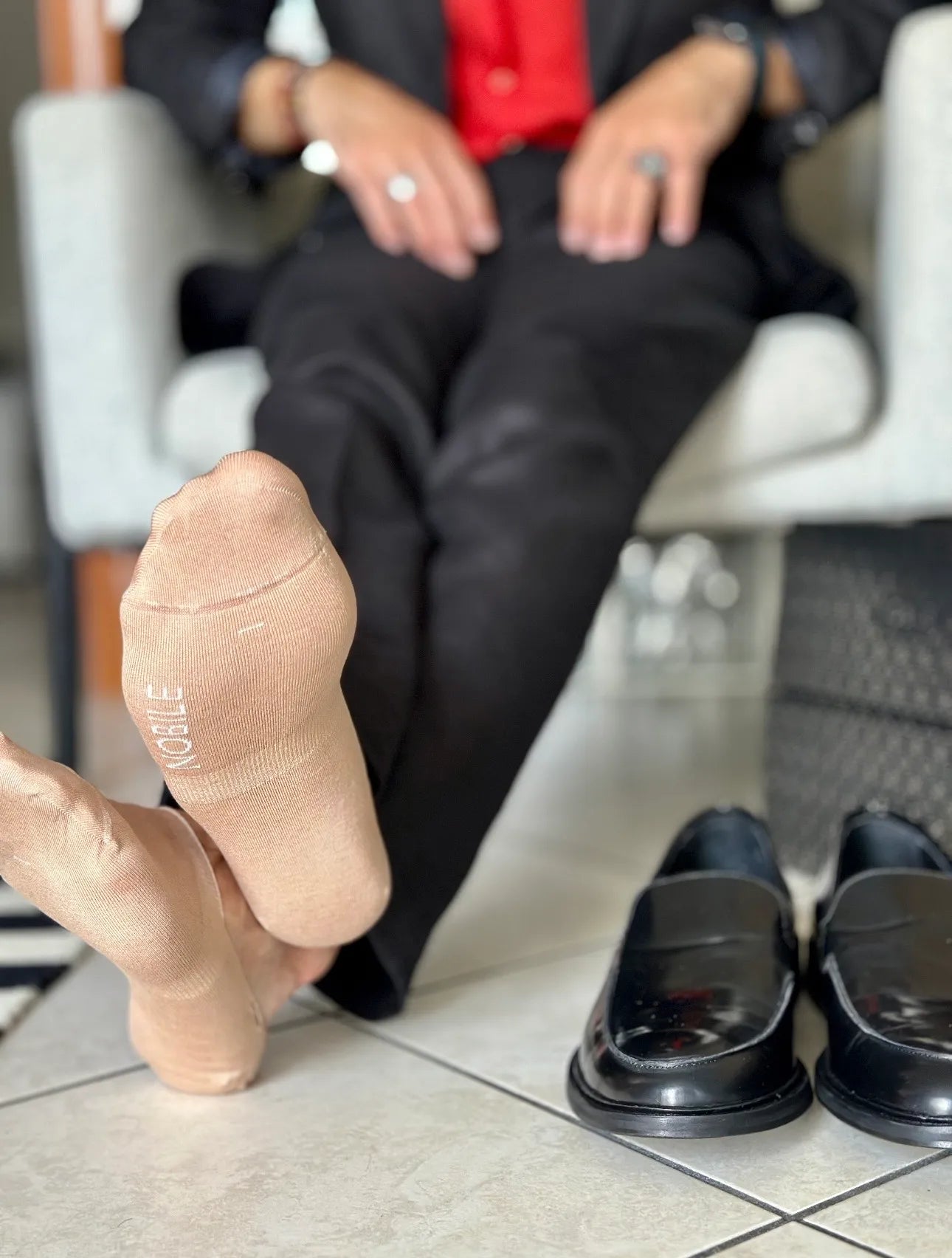
Women's Sock Sizes: The Dedicated Line
The women's line uses size ranges built around the female foot, more compact than the men's grid.
Two sizes cover most cases: 35-38 and 39-41. A lower shoe number falls into the first, from 39 upward into the second.
The difference from the men's line is real. Men's sizes start at 39-42 and climb in wider steps, designed for longer feet.
The women's ranges are narrower, so the sock hugs the foot without slipping at the heel.
The reference point stays the same: your European shoe number.
- Crew and ankle socks: follow 35-38 or 39-41 by your number. The right range keeps the sock from bunching at the ankle.
- No-show socks: here the exact fit lets them disappear inside the shoe. A female foot from 37 to 39 matches the 37-39 band, cut to stay hidden below a court shoe.
An example: a size 38 picks 35-38 in crew and ankle styles, and 37-39 in no-shows. At the edge, precision decides whether an invisible sock holds.
Two borderline cases deserve a clear answer. A female foot from 42 upward can consider the smallest men's size (39-42 on many styles), which gives more length.
The reverse holds too: if the men's 39-42 feels generous, the women's 35-38 offers a trimmer fit. The right sock is the one that fits, label aside.
If no standard range works, the made-to-measure option lets you order sizes outside the grid, with a minimum of six pairs per style and pattern.
Made-to-Measure Sizing: When Standard Isn't Enough
The EU ranges fit most feet, but not every foot. If you wear a 34 or a 51, or your instep sits outside the chart, you've probably settled for socks that pinch or slide down.
We took a different route.
With the "made-to-measure" option you can order a size larger or smaller than standard, built around your real needs.
Almost no maker offers this. It means working the way Racale always has: 240 needles, slow hand-finishing, every pair checked.
The six-pair minimum, and why
Made-to-measure is ordered with a minimum of six pairs per model. It isn't an arbitrary threshold: setting the machine for a dedicated size takes real work.
Six pairs of the same model give you over a week covered, in the same yarn and the same color.
Anyone with an off-chart foot knows the feeling. Finding the right sock once, and reordering it identical, is worth more than any single occasion.
Pairing made-to-measure with embroidered initials
A dedicated size isn't only for feet outside the range. It's for anyone who wants a wardrobe that holds together down to the hidden detail.
The exact color that follows a tailored suit, a gift for one person, initials embroidered on a pair that becomes truly theirs.
This is accessible luxury in the way that matters: not the logo on show, but the care only the wearer feels.
On sizing you're covered either way: you have 100 days to try them with a full refund. Wear the socks, wash them, test a full day.
If the size isn't right, send them back with no risk and we work out the correct one together.
Why the Yarn Matters as Much as the Size
The right size solves half the problem. The yarn decides the other half.
A synthetic sock, even in a flawless size, slips inside the shoe and overheats the foot after a few hours. The fibre doesn't breathe, doesn't wick moisture, and loses tension the moment it warms up.
Two socks in the same size can behave in opposite ways. A cheap fibre warps, goes shiny where it rubs, and never returns to its original measurement.
A fine yarn holds its shape wash after wash. It's not the wrong size: it's the wrong fibre.
This is why Nobile works only with noble yarns, chosen for how they behave once worn:
- Certified Filoscozia®: mercerised and gassed cotton, cool to wear with a soft sheen; ideal with tailored suits.
- Makò Cotton with extra-long fibres: soft, durable, gentle on the skin.
- Mulberry Silk: thermoregulating and feather-light, for occasions that count.
- Hircus goat Cashmere: warm without bulk, for the cold months.
On the Merino wool line the reference composition is 80% Merino wool, 18% nylon, 2% elastane.
The wool regulates temperature and keeps the foot dry, the nylon adds resilience, and the elastane does what size alone never can.
Stretch and Stay-Up: the Role of Elastane
That 2% of elastane decides whether a sock holds all day or gives way after a few hours.
It provides the recovery: the fabric moulds to the leg, hugs without squeezing, and snaps back after every step. Without quality elastane, even the exact size goes slack.
Shape That Lasts
A good yarn shows its worth at the fiftieth wash, not the first. The long fibres of Makò and the structure of Filoscozia® resist pilling, the cuff keeps its grip, and the fit stays true.
That's the difference between a big-name sock that no longer fits after two washes and one that stays true to itself, wash after wash.
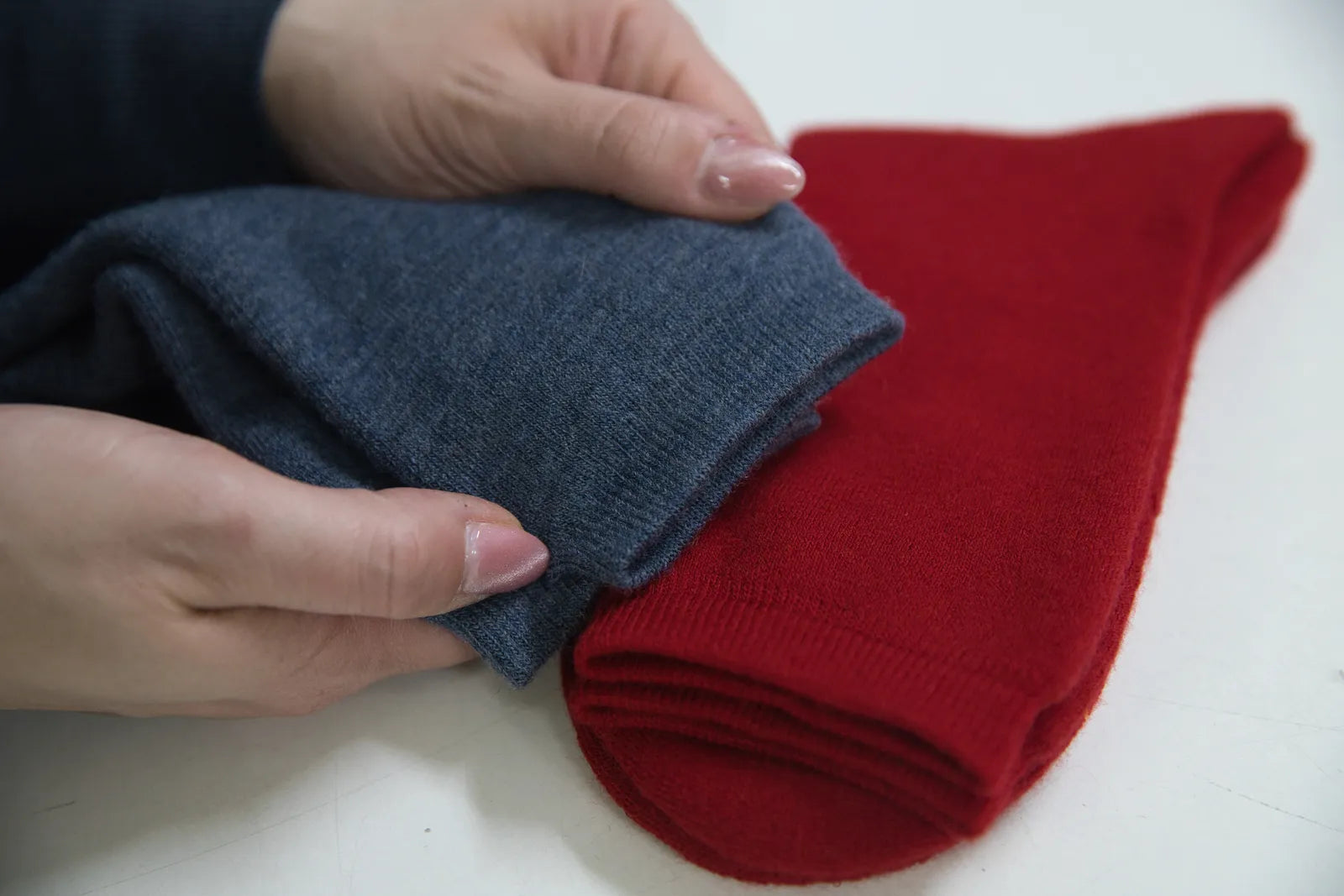
A look at the noble yarns Nobile Italy works with: the same diameter in microns doesn't mean the same performance. The right size only holds up if the yarn is good.
Combed, mercerised and gassed cotton, two-ply twisted. Compact and lustrous, it holds its shape and doesn't slip even at the end of the day.
A smooth, feather-light fibre that regulates temperature naturally. Silky against the skin, elegant under the most formal shoes.
The fibre's natural crimp traps warmth and gives it softness. An elastic hold that follows the calf without squeezing.
A long, even fibre that means fewer pills and more strength. Soft and breathable, it keeps its shape and colour wash after wash.
The reference composition of the Merino line. The nylon adds hold and abrasion resistance, the elastane keeps it stretchy and springing back into shape wash after wash.
The more natural crimp a fibre has, the more air, warmth and stretch it holds; a two-ply twisted yarn keeps its shape and colour better over time.
Mistakes to Avoid When Choosing Your Size
Most sizing errors come from five easy to fix habits. Seeing them clearly helps you get it right the first time.
Looking only at shoe size and forgetting the calf. For crew socks, foot size is enough.
For knee-high socks it isn't: two people in EU 43-46 can have very different calves. With a fuller calf, a foot-perfect size grips too tightly and leaves that red mark.
Measure the widest point before you decide.
Going a size up "to be comfortable". An oversized sock isn't more comfortable. It bunches under the shoe and slips down mid meeting.
Real comfort comes from the right size, not a loose one. A fine yarn performs only at its natural tension.
Forcing a size that's too small. Here it helps to know how the yarn behaves.
True Filoscozia and Makò cotton have a long, compact fibre: overstretched, it flattens, loses its soft hand and thins out sooner.
Mulberry silk and Hircus cashmere are even more sensitive, made to wrap the foot without constraint. If you have to tug a sock up, you're holding the size below.
Trusting the old Italian numbering as if it were exact. Numbers like 11 or 12 stay indicative and vary by half a size between makers.
We don't use them: we work from the real EU ranges. Start from your European shoe size and pick the matching range.
Getting the no-show size wrong. Tolerance is minimal: a loose no-show slips under the heel, a tight one works its way off.
Follow the dedicated ranges (37-39, 40-42, 43-45, 46-48) and don't map them onto crew sizes.
- Always choose the size that includes your shoe number.
- At the top of a range and unsure? Go with the larger size.
- On knee-highs, between two ranges, let your calf decide.
- Foot outside the standard range: consider made-to-measure.


Size picked from the shoe number alone, or a size up for "comfort": the sock bunches, slides down mid-meeting and the cuff leaves a red mark on the calf. Taking the old Italian numbering as exact and wearing the wrong no-show size only makes it worse.

Size chosen on the real EU range (M 39-42, L 43-46, XL 47-50), factoring in calf width on knee-highs. The sock stays put, no bunching, a cuff that leaves no mark. For no-show socks, use the dedicated ranges (37-39, 40-42, 43-45, 46-48).
The Right Size Shows Over Time, Not Just on Day One
A sock can feel perfect when you pull it on, then let you down a few hours later.
The real test isn't the mirror in the morning, it's how you feel at night: the sock still in place, no mark, your foot dry after ten hours.
Yarn matters as much as size. A Makò cotton with extra-long fibre, or genuine Filoscozia®, holds its shape wash after wash.
A cheap synthetic loses its tone within a fortnight and starts slipping down at the worst moment.
A well-sized sock doesn't give way at the cuff and leaves no red mark by day's end.
Too tight, the elastic makes itself felt; too loose, the sock bunches under the sole. The right size sits in between and disappears from your thoughts.
All of this begins before the pair reaches you. In Racale, in Salento, every pair goes through slow hand-pressing and its own quality check.
That's why a size that fits keeps fitting, instead of warping after the first wash.
Still caught between two sizes? Our 100-day trial with a full refund gives you time to judge: wear them, wash them, test them.
If they don't convince you, you get your money back in full.
To compare every EU range, the men's and women's lines and the no-show socks, start from our official size guide with the complete table.


Frequently asked questions
How do I choose my sock size if I wear a size 43?
At a size 43 you fall into size L, which covers EU 43-46. Since you sit at the start of the range, the sock fits comfortably without stretching. If you have a fuller calf and wear knee-high socks, L is still the right call, as the elastic knit adapts.
What shoe size does the old Italian sock size 11 correspond to?
Size 11 roughly matches a shoe size 41-42, though the conversion can shift by about half a size from one maker to another. Nobile doesn't use this numbering: a size 41 or 42 shoe falls within size M (EU 39-42). If your old 11s always felt a little snug, check the EU range in the chart anyway.
Why do no-show socks use a different size from regular socks?
No-show socks use tighter ranges (37-39, 40-42, 43-45, 46-48) because they must hug the heel and stay hidden inside the shoe. The wrong size makes them slip down as you walk. Pick the range that contains your exact size, without rounding up.
Is it better to size up on socks for comfort?
No. Sizing up makes the sock bunch under the foot and slip inside the shoe, causing discomfort and early wear. The right sock should sit snug without stretching or bagging. If you're between two sizes, choose the one that contains your shoe size.
What if my foot falls outside the standard sizes?
You can order a made-to-measure size from the dedicated option, larger or smaller than standard, with a minimum of 6 pairs per model or pattern. It's the solution for feet outside the scale or anyone wanting an exact fit. You also have 100 days to try them with a full refund if needed.
Are women's sock sizes the same as men's?
No, the women's line has its own ranges: 35-38 and 39-41. If you're a woman with a size 42 foot or larger, the men's size M (EU 39-42) is worth a look. For smaller men's feet, many of our men's styles also come in 35-38. The rule never changes: pick the range that includes your shoe size.
Does sock size change after washing?
With a poor yarn, yes: a sock can shrink, lose its shape or its stretch after just a few washes. With fine yarns such as genuine Filoscozia®, Makò cotton or Merino wool, and a dense knit, the shape holds over time. Wash at low temperatures, inside out, and skip the tumble dryer: the fit stays just as it was on day one.