An invitation that reads black tie isn't asking for any dark suit. It's asking for a tuxedo.
It's the most precise evening dress code there is, meant for events that start after 6 or 7 pm.
Here's a concrete example. The invitation arrives for a charity gala or an evening wedding, starting at 8:30 pm.
The right call is a black or midnight-blue jacket with satin lapels, trousers without cuffs and a silk side stripe, a white shirt with cufflinks and a hand-tied black bow tie.
This guide covers the rules that matter, the most common mistakes and the details that separate a well-dressed man from one who has truly understood the code.
One of them gets overlooked far too often and counts for more than it seems: the sock.
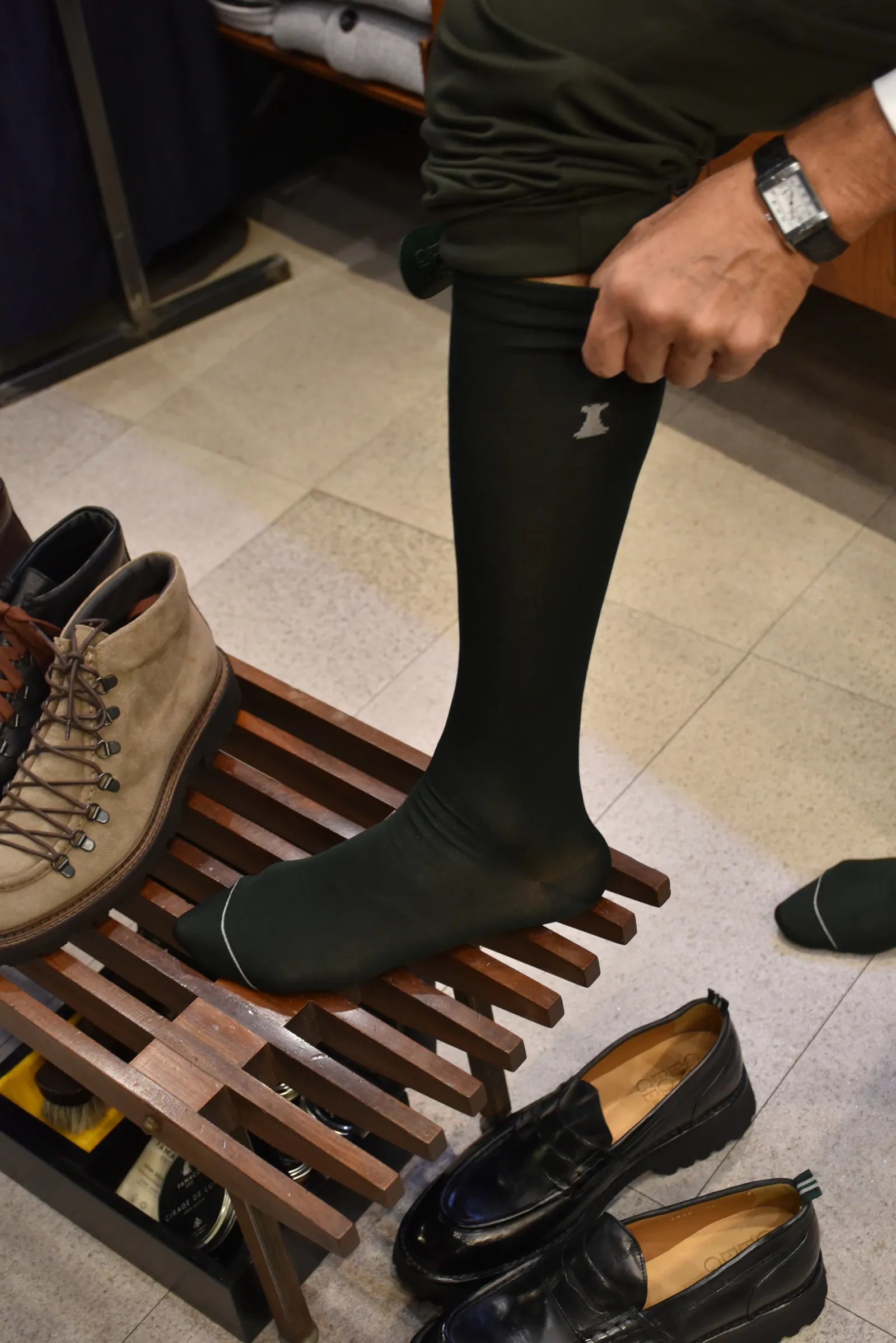
The tuxedo sock is long and black, matched to trousers and shoes, so that not an inch of skin shows when you sit down.
It's an invisible detail while everything is in place, and an awkward one when it isn't.
Whether you choose a tuxedo for the love of fine things or wear it out of duty, after ten hours on your feet you want a yarn that stays luminous and a foot that stays cool and dry, with no marks.
Our Mulberry Silk collection shows why the right yarn changes the whole evening.
What Black Tie Actually Means
When an invitation says "black tie", it asks for one specific thing: a tuxedo, meaning the black or midnight-blue dinner jacket with satin or grosgrain lapels. It isn't a vague request to dress well; it's a code with fixed rules, born in 1886 as a more comfortable alternative to the tailcoat for men's evenings, from club dinners to private balls.
Here's the detail that reassures anyone worried about getting it wrong: black tie is an evening code. You wear it after sunset, roughly from 6 or 7 pm onwards. During the day a tuxedo is out of place, and an 11 am wedding almost never calls for one.
Black Tie, White Tie or Dark Suit?
Three labels that look similar yet change everything. Mixing them up is the most common mistake, and it's easy to avoid once you know the hierarchy of evening formality.
- Black tie: a tuxedo, a hand-tied black bow tie, a white shirt with double cuffs. This is the code for galas, theatre premieres, formal dinners and evening weddings.
- White tie: the tailcoat, with a white waistcoat and white bow tie. The highest tier, reserved for state ceremonies and grand receptions. More formal, far rarer.
- Dark suit (business formal): a classic navy or charcoal suit with a tie. Elegant, but not a tuxedo; wearing it where black tie is required is a step down.
A detail few people know: midnight blue under the artificial light of a ballroom reads blacker than black itself, because it doesn't pick up the warm glow of the lamps. That's why many tailors prefer it to true black.
And if the invitation is vague and never names the code? Read the time and the venue: dinner after 7 pm in a hotel, a theatre or a villa almost always means a tuxedo. If it says "gala evening" or "black tie", there's no doubt left.
The touch that completes the look stays hidden until you sit down: a long black sock in Mulberry Silk, soft and luminous even after many washes, so your skin never shows. Discover it in the Mulberry Silk socks collection.
The Tuxedo Jacket: Lapels, Color and Fabric
A tuxedo jacket is black or midnight blue, never grey or brown. The color is a given; the character comes from satin or grosgrain lapels that catch the light while the body of the jacket stays matte. That play of shine against matte is the tuxedo's signature.
Midnight blue has a precise technical reason behind it. Under warm, incandescent room lighting, true black absorbs the light and reads washed out, almost dusty. Midnight blue reflects less of it and stays deep, so in the evening, under the chandeliers, it looks blacker than black itself.
Only two lapels belong here, and the cut sets the register of the jacket:
- Peak lapels: points angled upward, a sharper and more authoritative line. The ideal choice for the most ceremonial evenings, a gala or a theatre première, and the natural companion to a double-breasted cut.
- Shawl lapels: a single curved line with no corners. Softer and more relaxed, perfect on a one-button single-breasted jacket for an elegant dinner or New Year's Eve.
Notch lapels are out of place. They belong to the daytime suit, and on an evening jacket they give the game away at once: it is probably the most common flaw in off-the-rack tuxedos.
At the front, two legitimate choices. The one-button single-breasted lengthens the figure and keeps the chest line clean, ideal with a cummerbund. The double-breasted is more structured and always worn closed.
Coherence of black is what matters: the satin of the lapels should echo the silk stripe on the trousers and, ideally, the bow tie. In the same spirit, sock and shoe should share the same deep black, with no visible break. That is why a long black Knee-High Sock in Mulberry Silk finishes the figure with a quiet luminosity. How to pick the right sock is covered in this guide to socks under a formal outfit.

Trousers, Shirt and Bow Tie: The Rules You Don't See but Everyone Notices
A tuxedo earns respect through details nobody mentions out loud yet everyone clocks. The trousers have no turn-up, sit high on the waist, and carry a silk side stripe (the galon) matched to the lapel fabric: satin with satin lapels, grosgrain with grosgrain.
The high waist is not a flourish. It covers the point where shirt meets trouser so that, seated at a gala dinner, no rumpled band of fabric breaks the line.
Why braces, never a belt
Tuxedo trousers are held by braces, never a belt. A buckle interrupts the silk stripe and creates bulk under a buttoned jacket, while braces hold the waist exactly where it should be after hours on your feet.
The result is a clean line: no bunching near the lapel and nothing cinching your waist by the end of the night, when dinner runs long.
The shirt is white, with a classic or wing collar and double cuffs for cufflinks. Choose a stiff bib for the most formal galas, where it gives the chest real structure; a soft pleated front or a plain front stays correct for less rigid evening dinners.
The bow tie is tied by hand
The black bow tie must be self-tied, never pre-knotted. Its silk should match the lapel, so the two blacks speak to each other instead of clashing. A hand-tied knot has slightly uneven folds, and that imperfection is exactly what signals it is real.
If you have never done it, it is easier than it looks: the steps are in the tutorial just below, far clearer with a mirror in front of you or a short video for reference.
It is these three choices, held together with care, that build the final effect. None stands out on its own, but their sum is what separates an outfit worn with attention from one thrown on in a rush.
The knot that makes the difference
How to tie a tuxedo bow tie
A self-tie bow tie, never pre-tied, keeps a touch of irregularity: that slight imperfection is exactly what reads as care and authenticity. A few moves in front of the mirror are all it takes.
What you need
-
1
Set the length
Drape the bow tie around your neck, over the buttoned shirt. Leave one side about five centimetres longer than the other. That first adjustment decides the final symmetry.
-
2
First cross
Bring the long side over the short one and pass it underneath, pulling it up. Hold it in place with a finger at the centre, where the knot will form.
-
3
Shape the bow
Fold the short side into a horizontal bow, centred at your neck. Let the long side drop in front of the bow, covering it halfway.
-
4
Close the knot
Fold the long side as well and push it through the loop behind the first bow. Gently pull the two wings until the centre tightens.
-
5
Adjust and check
Arrange the folds so they stay slightly asymmetric: a bow tie that looks too perfect reads as fake. Make sure the silk is the same satin or gros-grain as the lapel.
Recommended product: Nobile Luxury Essential, Knee-High Socks in pure Mulberry Silk
-
Expert tip
Uncuffed trousers with a silk braid down the side, high waist held by braces and never by a belt: the black knee-high socks in pure silk complete the colour line between trousers, knot and shoes, even when you sit down.
Cummerbund or Waistcoat: How to Finish the Waist
Between the shirt and the trousers lies one spot a tuxedo never leaves bare: the waistline, with the trouser hook and buttons. A cummerbund or a low-cut waistcoat exists precisely to cover that area and carry the eye in one clean vertical line, from the bow tie down to the shoes.
The cummerbund is the classic choice. It sits snug against the waist, in black satin or grosgrain, and the pleats always face upward. The story goes that those open folds once held a theatre ticket. Anecdote or not, the upward orientation is still the correct rule today.
The waistcoat suits anyone who prefers a more structured finish. It needs a deep V-shaped neckline, so it stays hidden under the buttoned jacket and frames the shirt front, the stiff plastron of a starched evening shirt. A V cut too high would hide that front, which is the visual centre of the whole outfit, while a waistcoat that rides up peeks past the lapels and breaks the line.
When each one works best
- Cummerbund: cooler and lighter, ideal for summer evenings, long dinners and warm rooms. It unhooks in a moment when you sit down.
- Waistcoat: warmer and more covering, perfect for winter galas and formal settings where the jacket stays on all evening.
One rule of harmony holds: cummerbund and bow tie must speak the same language in fabric. If the bow tie is satin, the cummerbund is satin; if it's grosgrain, follow the same thread. The most common slip is a hybrid mix, say a glossy satin cummerbund under a bow tie and lapels in matte grosgrain, where the two finishes clash under the lights. For the other pieces that need to agree, the overview of men's formal attire is a useful reference.
One last point: never wear a cummerbund and a waistcoat together. Pick one and let it bridge torso and legs cleanly, keeping the vertical line that holds the whole outfit together.
Tuxedo Shoes: Patent Leather or Polished Calfskin
A tuxedo asks for a black, gleaming shoe, with no exceptions. Two routes are correct: patent leather, mirror-bright, or hand-polished calfskin worked to a high shine.
The reasoning is aesthetic before it is formal. A glossy upper carries on the play of light from the satin lapels and the silk stripe down the trouser, drawing a clean, unbroken line from knee to toe. A matte or pebbled shoe kills that reflection and instantly lowers the register of the evening.
Black tie allows two models:
- Closed oxford (internal lacing, lean silhouette): the versatile choice, elegant with any tuxedo.
- Evening pump, historically known as the opera pump: the slipper with a flat grosgrain bow in black, the same cloth as the bow tie, the most formal and theatrical option, ideal for galas and premieres.
Outside the code sit the open derby (external lacing, too daytime), the casual loafer, and anything brown or suede. One stray tone at your feet and the whole outfit loses its credibility.
This is where socks become decisive. The run from trouser to sock to shoe must be all black and continuous.
No sliver of skin, no short sock exposing the ankle when you cross your legs. That is why the right sock is long, black and spun from a fine fibre. The Nobile Luxury Essential Knee-High Socks in Mulberry Silk (47.50 euros), or the sheer Chiffon version in a fine knit (49.50 euros), keep the black deep even under the room's lights.
If you want every detail right from the shoe up, you will find the models, finishes and correct pairings in our guide to men's wedding attire.
The Right Sock With a Tuxedo: Long, Black, in Silk
This is where mistakes cost you, and everyone sees them at once. Black tie has one rule: long black socks, matched to your trousers and shoes, so no strip of skin ever shows when you sit down.
No crew socks, no no-show socks, no patterns or colours. The tuxedo sock has to disappear into the outfit, and that is exactly its job.
Why they have to be long
At a gala or a formal dinner, crossing your legs while seated is normal. The second you do, a short sock bares your calf and the whole look falls apart.
Knee-high socks reach above the calf and stay put without pinching. The difference shows the moment you sit:
- Crew or no-show socks: bare skin as soon as you cross your legs, the most visible mistake of the evening.
- Long black socks: a seamless line from trouser to shoe, standing or seated.
To see how much this detail shapes the final result, read how the right socks finish a sophisticated outfit.
The Nobile choice for a tuxedo
For a black tie evening, the pick is the Nobile Luxury Essential Knee-High Socks in Mulberry Silk (80% pure class A mulberry silk, 18% Oeko-Tex® certified nylon, 2% Lycra®, 47.50 euro). Light and luminous even after many washes, with a quiet sheen that echoes the satin lapels.
The silk is soft, breathable and leaves no red marks, so your foot stays fresh and dry all evening. If you want an even sheerer look, the finer-knit Chiffon in Mulberry Silk (49.50 euro) is thinner, with a graduated knit that stays up without squeezing.
Every pair is made in Racale, slowly hand-pressed and checked one by one. If formal evenings keep returning to your calendar, the box of 6 black pairs keeps a clean one always ready. For winter, the black knee-high in Hircus goat cashmere is an excellent alternative. Find them among the Mulberry Silk socks.
Silk or Cashmere: Which Black Sock for Which Evening
Under a tuxedo the sock is always long and black: the yarn changes, and with it how your foot feels and the evening it suits. Two choices, one rule of elegance.
Mulberry silk is the all-year option, and the only sensible one when the evening runs warm: a gala dinner in June, a summer evening wedding, a crowded room. It keeps the foot cool and dry, and brings a quiet luminosity that flatters the black of the trouser.
The Nobile Luxury Essential knee-high has a fuller hand; the fine-knit Chiffon is sheerer, with a graduated knit that stays up without gripping the calf. For why the fibre matters on an evening like this, read our guide to elegant men's socks.
Hircus goat cashmere comes into its own in winter: New Year's Eve, an opening night in January, an under-heated villa. Soft and warm without bulking up the line of the shoe, it leaves no redness and stays discreet, exactly as black tie demands.
The visual difference is subtle but legible. Silk gives a barely-there sheen that converses with the satin of the lapels; cashmere stays matte and cushioned, with a fuller visual weight. Neither should draw the eye: the right sock is the one you don't notice.
The practical advice is simple. If your evenings fall across the year or in the warmer months, silk is the more versatile answer; Mulberry silk also comes in a box of 6 black pairs, handy when invitations cluster close together. Cashmere stays the natural choice for deep winter.
Choose yours from the Mulberry silk socks and the long black Hircus cashmere version, both made to stay up all evening without leaving a mark on the calf.
Mulberry silk or Cashmere Hircus: the right black sock for your evening
| Criterion | Mulberry silk | Hircus goat cashmere |
|---|---|---|
| Season | Year-round, perfect for warm evenings and summer galas | Winter and cold settings, dinners and parties in the colder months |
| Hand feel | Cool, light and luminous against the skin | Soft and warm, enveloping |
| Breathability | Breathable, keeps the foot cool and dry | Light and breathable, thermoregulating |
| Visual effect | Luminous, sheer black, elegant under tuxedo trousers | Deep matte black, discreet and warm |
| Composition | 80% pure class A mulberry silk, 18% Oeko-Tex® nylon, 2% Lycra® (Chiffon: 94% silk, 4% nylon, 2% Lycra®) | 95% Hircus laniger goat cashmere, 3% Oeko-Tex® nylon, 2% Lycra® |
| Reference price | Luxury Essential knee-high 47.50 euro, Chiffon knee-high 49.50 euro | Luxury Essential knee-high 84.50 euro, Chiffon knee-high 94.50 euro |
Nobile Yarns and Why They Matter on a Night Like This
A tuxedo sock is a hidden detail that shows itself exactly in the key moments: when you sit down, cross your legs, or dance and the trouser rides up a few centimetres. In that instant the yarn matters, not the pattern.
The colour is fixed and so is the length, which leaves the fibre to decide whether a sock carries the evening or lets it down. For evening black we recommend two fibres, and it's worth knowing how each behaves.
Mulberry silk is class A, the longest and most uniform grade, which is where the lasting luminosity and the cool hand on the foot come from. The nylon is Oeko-Tex® certified, and the Lycra® adds stretch without stiffening the sock.
Hircus laniger goat cashmere is the winter alternative: the same deep black, with the soft warmth of a noble fibre and a breathability that surprises.
Both pass a check on every pair: the step that gives a fine yarn the finish the evening asks for.
For black tie, start with the black knee-high sock in Mulberry silk, Luxury Essential or Chiffon, also in the box of 6 black pairs.
If you want to understand how silk behaves against the skin and why it stays luminous over time, you'll find it all in our guide to elegant men's socks.
Mulberry silk or Cashmere Hircus: the right fibre for evening black
Your tuxedo sock stays hidden until you sit, cross your legs or dance. In that moment it shows, and it has to measure up. Here is how the two noble fibres made for evening black compare.
80% pure Class A Mulberry silk, 18% Oeko-Tex® certified nylon, 2% Lycra®. Light and breathable, it keeps the foot cool and dry, and stays luminous even after many washes.
94% Class A Mulberry silk, 4% nylon, 2% Lycra®. Lighter and sheerer, with a graduated knit that stays up without squeezing. The most discreet choice under evening trousers.
95% Hircus laniger goat cashmere, 3% Oeko-Tex® certified nylon, 2% Lycra®. Soft, it leaves no redness or irritation, and keeps the foot warm and dry on cold evenings.
A lower micron count means a finer fibre, gentler on the skin; silk has no crimp and falls smooth under trousers, while cashmere has a natural crimp that holds in warmth. Every pair is born in Racale and passes its own single quality check. Want to know more about silk? Read the guide to <a href="https://nobileitaly.com/blogs/nobile-blog/calze-di-seta-uomo?utm_source=blog&utm_medium=internal&utm_campaign=smoking-uomo">men's silk socks</a>.
The White Tuxedo and Summer Variations
The white or ivory jacket exists, but it belongs to one season only. It's called the dinner jacket, and its rules are strict: summer only, outdoors, and only for evening events in warm or luxury seaside settings.
It was born in the 1930s on cruises and tropical resorts, when a dark jacket became unbearable under the sun. That's why the classic summer version is cut in silk shantung or light cotton, fabrics that breathe and cope with the evening heat.
Fix this principle: only the jacket changes. Everything else in a black tie outfit stays exactly as it is in the dark version.
- White or ivory jacket, with peak or shawl lapels in satin;
- Black trousers, no turn-ups, with a silk side stripe;
- A black bow tie you tie yourself, plus a black cummerbund if the jacket sits open at the front;
- Black shoes in patent leather or polished calf, oxford or pump.
Trousers, bow tie and shoes stay black, and so do the socks: long and black, never short, never coloured, never on show when you sit down.
Picture a summer gala on the coast, or an outdoor evening wedding after seven, with the ceremony in a garden and dinner under a pergola. That's the exact home of the dinner jacket: warm air, low light, a relaxed yet luxurious mood.
The classic mistake is wearing it in the city or in winter. Imagine a theatre foyer lit up in December: the white jacket catches the lights like a beacon among dozens of dark suits, and instead of setting you apart it signals the code was misread. When in doubt, stay with the dark tuxedo: it never lets you down.
A warm evening puts the sock to the test. You want a fibre that keeps the foot fresh and dry right through dinner, light and breathable, leaving no marks under the calf. The Nobile Luxury Essential Knee-High Socks in pure Mulberry Silk (47.50 euro) do precisely that, and they stay luminous even after many washes. For the full reasoning, read our guide to elegant men's socks.
Black Tie Mistakes to Avoid
Black tie leaves little room for error, and it's almost always the details that give you away. The most common slips are also the easiest to fix, if you catch them before you leave the house.
- Pre-tied bow tie: the clip showing at the collar is spotted at once, tie it by hand, a touch imperfect is fine, even preferable.
- A belt instead of braces: the trousers have no loops and are held up by braces, while a cummerbund or waistcoat conceals the waistline.
- Brown or casual shoes: black only, in patent or polished calf (oxford or pump). See the guide to formal menswear.
- Notch lapels: a tuxedo calls for peak or shawl lapels, in satin or grosgrain.
- A dark suit passed off as a tuxedo: without the silk stripe on the trousers and glossy lapels, it stays a suit, not black tie.
- A shirt with visible buttons and no cufflinks: you want double cuffs and cufflinks, ideally with a bib or pleated front.
- A white tuxedo in winter or in town: ivory is for summer and outdoors only.
- A tuxedo in daylight: it belongs after 6 or 7 pm, to evening events.
The most common mistake, and the most visible the moment you sit down, is the socks. Short or coloured ones bare your calf at exactly the wrong time: at the table, during a toast, in the front row at a gala.
The rule has a precise measure: the sock must reach above the calf, in black, so no bare leg ever shows when seated. A detail no one notices when it's right, yet everyone senses when it's wrong.
To sidestep this slip for good, read how the right socks finish a sophisticated outfit. The Nobile Luxury Essential in pure class A mulberry silk, long and black (47.50 euros), stays smooth and luminous even after many evenings.

Caring for Your Tuxedo and Socks After the Night
Care starts the moment you walk back in. Hang the jacket right away on a wide, shaped wooden hanger that supports the shoulders without distorting them, then let the suit breathe for a few hours before putting it away.
The satin on the lapels and the trouser stripe catch dust and faint marks. Brush it gently, following the grain, with a soft clothes brush: it lifts away residue and crumbs without roughing up the lustrous weave.
Dry cleaning belongs to real stains or the end of the season, not to every wear. Over-cleaning dulls the satin and tires the shape, so fewer washes, more daily upkeep is the rule of anyone who keeps a tuxedo for years.
A white or ivory dinner jacket needs an extra eye. Store it in a cotton garment bag, never in plastic that yellows the fibre, and keep it clear of perfume sprayed straight onto the cloth: on a pale jacket every mark shows at once.
Black silk or cashmere socks ask for the same care. Mulberry silk stays luminous wash after wash, but only when handled well.
- Hand-wash in cold water, or machine-wash inside a mesh bag on a delicate cycle.
- A mild detergent, with no harsh softener that weighs the fibre down.
- No twisting: press out excess water between two towels.
- Dry flat, away from radiators and direct sun.
Treated this way, a fine sock lasts whole seasons. For your next formal evening the right choice is the Nobile Luxury Essential Knee-High Socks in Mulberry Silk (47.50 euro), black and soft, or the finer-knit Chiffon for a lighter, sheerer veil.
A brushed jacket, a long sock that stays up and leaves no red mark: it's the cared-for details that set apart the man who truly knows how to wear a tuxedo from the one who simply puts one on. For more on the yarns, see our guide to elegant men's socks.
Frequently asked questions
Are a tuxedo and black tie the same thing?
In practice, yes: black tie is the dress code and the tuxedo is the garment that meets it. When an invitation says black tie, it asks for a black or midnight-blue tuxedo, not just a dark suit. It's a code meant for evening events, after 6 or 7 pm.
What socks do you wear with a tuxedo?
Long black socks, matching the trousers and shoes, so no skin ever shows when you sit down. The most refined choice is mulberry silk, light and lustrous; in winter black cashmere works well too. Never crew socks, no-show socks or contrasting colors.
Can I wear a belt with a tuxedo?
No, a tuxedo doesn't take a belt. The trousers are held up with braces, and the waist is finished with a cummerbund or a low waistcoat. A belt would break the clean, vertical line of evening dress.
Can the tuxedo bow tie be pre-tied?
Ideally no: the black bow tie should be hand-tied, because a slightly imperfect knot shows you tied it yourself. A pre-tied one looks stiff and gets noticed. Choose silk that matches the lapel and cummerbund.
Black or midnight-blue tuxedo?
Both are correct. Under artificial evening light, midnight blue often reads deeper and even blacker than black, with a very refined effect. Black remains the most classic and versatile choice for any black tie event.
When can you wear a white tuxedo?
Only in summer, in the evening and outdoors, in warm or elegant resort settings. The jacket is white or ivory, but trousers, bow tie and shoes stay black, and the long black sock stays the same. In the city or in winter it's out of place.
What shoes go with a tuxedo?
Black shoes in patent leather or polished calfskin: closed oxfords or evening pumps with a grosgrain bow. No open derbies, casual loafers or colors other than black. The shoe should continue the trouser-sock-shoe line, all black and glossy.
How do you wash silk socks after a formal evening?
By hand or in a wash bag, in cold water, with a gentle detergent and no harsh softeners. Dry them flat, away from direct heat. That way mulberry silk stays lustrous and soft even after many washes.
Keep reading

Men's Formal Attire: A Complete Style Guide for Every Occasion
13 May 2026

Men's Cashmere Socks: Why Hircus Cashmere Makes the Difference
11 November 2026

Elegant men's socks: the finishing touch for a sophisticated outfit
23 April 2024

Men's Elegant Dress Code: Complete Guide for Every Occasion
12 February 2026

The secret to an impeccable Business Dress Code
10 September 2024